Special report by PEOPLE’S WORLD


 Latest editorial
Culture and the class war in Italy — from the Venice Biennale to Berlinguer’s legacy
NICK WRIGHT considers how the isolation of Israel and a new film on the controversial Italian communist leader are creating new reference points for Italy’s left
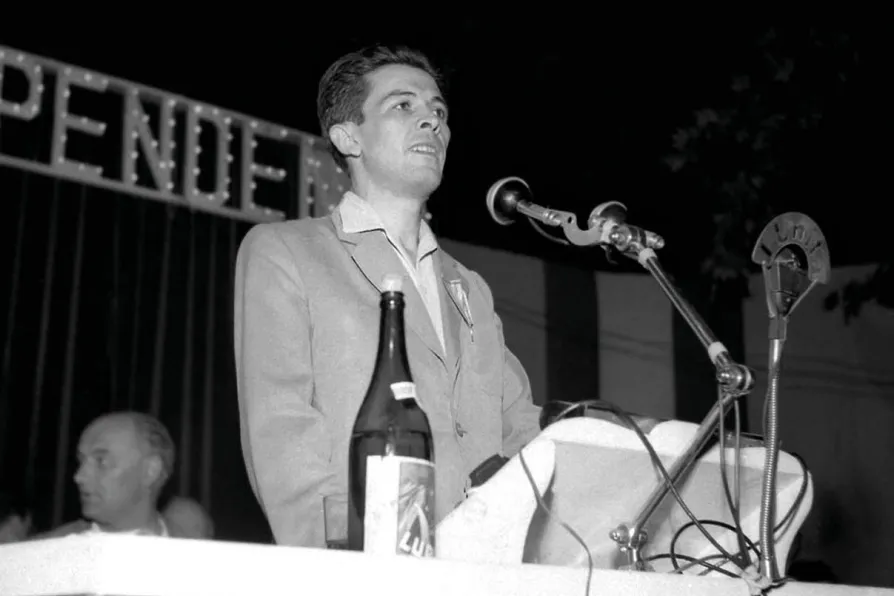 Enrico Berlinguer
CARLOS MARTINEZ says Cuba’s achievements in the face of a criminal blockade are startling, but the island’s future if the United States succeeds in crushing it looks bleak
AMNON BROWNFIELD STEIN reports that far-right MPs who mobbed the event organised by Hadash may have helped raise awareness of the brutality of the Israeli right
Born on this day in 1931, the heroic revolutionary faces a dangerous new wave of White House aggression. We must treat his birthday as a rallying cry to resist the illegal siege of Cuba, writes ROGER McKENZIE
RAMZY BAROUD decries the rats of Gaza, the rodent and human type. Both abound as profiteering from tragedy reaches obscene levels




GIORGIA MELONI’S demand for an apology from Israel after Italian Palestinian solidarity activists were arrested on the multi-nation Gaza aid flotilla is a breach in the European Union’s wall of support for the zionist state.
The 50 vessels that made up the solidarity armada were interdicted by Israeli Defence Forces warships in international waters and 400 people from dozens of countries were detained and taken to Israel.
What triggered the Italian prime minister’s demand was a video posted by Israel’s national security minister — the far-right figure Itamar Ben-Gvir — where he is shown taunting the captured flotilla members forced to kneel in a humiliating posture with their hands shackled behind their backs.
“Welcome to Israel. We are the landlords,” said Ben-Gvir.
In unprecedented strong language an Italian Foreign Affairs Ministry statement condemned as unacceptable “that these protesters, including many Italian citizens, are subjected to this treatment that violates their human dignity.”
And in demanding an apology for their treatment Foreign Minister Antonio Tajani — himself the leader of the right-wing coalition partner Forza Italia — was angered by “the total disregard shown for the Italian government’s explicit requests.”
In a hurried attempt to limit the political damage Israeli Prime Minister Benjamin Netanyahu distanced himself and his government from Ben-Gvir’s video, claiming the national security minister’s actions were “not in line with Israel’s values and norms.”
Former Italian prime minister Giuseppe Conte said he had lost contact with his fellow Five Star Movement deputy Dario Carotenuto.
Two weeks ago Carotenuto and left-wing journalist Alessandro Mantovani were deported back to Italy and gave graphic accounts of how they and fellow detainees were handcuffed, physically assaulted and blindfolded.
This followed another challenge to Israel’s international standing when 113 international artists and 18 national pavilion teams made a bid — earlier in the month — to shut down the Israeli pavilion at the Venice Biennale.
Organising the action was the Art Not Genocide Alliance (ANGA) which worked with campaign groups and Italy’s growing grassroots unions to organise a strike to protest at the Israeli presence.
More than two dozen national pavilions were affected by the strike with the Belgian, Egyptian, South Korean, Austrian, Japanese and Dutch shows closed while the pavilions of Britain, Cyprus, Ecuador, Estonia, Finland, France, Iceland, Lebanon, Luxembourg, Poland, Portugal, Switzerland, Turkey, and Ukraine also closed fully or partially.
ANGA claimed that the strike was the largest in the Biennale’s history.
It is not unusual for the event to be shot through with politics. This year was no exception where in addition to the widespread condemnation of Israel the Italian culture minister said he would boycott the festival opening over Russia’s participation.
The political controversy intensified after the death of Koyo Kouoch, chosen in 2024 as the curator of the 2026 Biennale. She was an immensely powerful and popular figure, a fierce partisan of African art challenging the cultural dominance of North America and Europe.
Her combative stance — she said that she wanted to really reflect on art, on artistic practice, and to contribute to the understanding of artistic practice as its own system of thought and as a mechanism for participating in visual culture, society, politics — was uncomfortable for the right.
Her successor, Pietrangelo Buttafuoco, is equally uncomfortable for Italy’s generally progressive-minded and liberal cultural milieu. But Buttafuoco’s nomination was celebrated by Raffaele Speranzon (of Meloni’s Fratelli d’Italia) :
“Another glass ceiling has been broken,” said Speranzon. “Often, the Biennale Foundation has been considered by the left as a fiefdom in which to place friends and acolytes. Buttafuoco, finally, affirms a change that the Meloni government wants to imprint in every cultural and social centre of the nation.”
Buttafuoco is a former member of Mussolini’s successor party, the Movimento Sociale Italiano and its successor the neo-fascist Allianza Nazionale.
***
It is in this moment that the 2014 film by Andre Segre, Berlinguer — The Great Ambition has struck a new note of reflection not just with the older generation who recall the time when Italy’s historic Communist Party challenged for a government majority, but also for a younger generation trying to understand and navigate Italy’s present complexity.
Segre wrote: “When a year ago I saw tens of thousands of 20 and 30-year-olds filling theatres to see our film, I told myself that it was not only interesting, but also important to stop and understand what was happening. So I invited some of those spectators, chosen for their diversity rather than homogeneity, but with some shared experience of civic and political activism, to roundtable discussions where there were only two rules: keep your cell phone turned off and don’t talk about Berlinguer and the PCI of the 1970s, but about themselves and the world today.”
He reported: “And indeed, what I witnessed and filmed in those roundtable discussions was a laborious yet conscious search for a collective identity capable not only of containing diversity, but also of freeing us from the distressing and suffocating trap of individual and selective identity to which neoliberal society and information technology have consigned us.”
Il Manifesto — nominally a communist newspaper but actually more reflective of Italy’s problematic and diverse left liberal currents — commented: “Touching on those years and touching on the Berlinguer of those years (historic compromise, national unity, austerity, the strategy of firmness in the face of Moro’s kidnapping) means touching on a raw nerve.”
The strategy of “compromiso storico” and the political crisis which saw Italy’s Christian Democrat prime minister Aldo Moro engage with the PCI in a complex struggle for hegemony reached an untidy resolution with Moro’s kidnapping by the ultra-left Brigate Rosse.
His eventual and inevitable killing — in circumstances where the characteristic interaction of the extreme right, the political establishment, criminal networks and the intervention of the US acting with Italy’s own intelligence outfits made this a torturous drama — remains controversial to this day.
An attractive and complex political actor, Enrico Berlinguer is the reference point for many in the present day Partito Comunista Italiano (and the residual left in the Partito Democratico) but remains a problematic figure for many of the other communist formations in Italy’s organisationally diverse left.
It was under his leadership that the PCI began the break with the Soviet Union that raised the growing differences in the international communist movement to a programmatic level and, in the Italian context, gave Moro the opportunity to realise his strategic aim of including the PCI in a government majority.
While judgement on his role in the rise, division and defeat of the historic post-war left and its role in government remains contested, Segre’s film has given young Italians an historic reference point for present-day politics.
The political problem in contemporary Italy is broadly the same as in the rest of the developed capitalist world — how is the absence from political power, and even from political life, of the working class to be addressed in what is quickly becoming a worldwide systemic crisis of capitalism.
Returning to examine the moment of the 1970s where fascism was defeated in Spain, Portugal and Greece; when the liberation of Portugal’s African colonies presaged the liberation of Southern Africa; when a socialist bloc of nations offered a compelling example of working-class power and solidarity with the national liberation movement exemplified by Vietnam’s victory over imperialism — cannot but be instructive to a new generation.
This opened up a quarter century of political crisis which resulted in the historic defeat of the working class in advanced capitalist countries and the world historic defeat of working-class state power.
In Italy — governed by an alliance of Fratelli d’Italia’s post-fascists and actual fascists with Forza Italia’s right-wing Christian democracy and the provincial chauvinism of Lega — the problem of power is centre stage.
Segre presents the drama of Berlinguer’s life around his emblematic use of the term “noi” (we or us) to highlight the existential crisis experienced by many young people in Italy.
He makes the point that material conditions have changed and — referencing identity politics — argues that the construction of the “we” “to which Berlinguer dedicated his life drew on the tools and characteristics of that world and time.”
“It is for this reason that the ‘we’ cannot be reused or recycled today but from the dialogues developed by the film: That ‘we’ contains two characteristics that can still form the structural basis of a collective and common identity: on the one hand, recognising, beyond diversity (and therefore also within diversity), common problems linked to conditions of social injustice produced by a stronger (or apparently stronger) power, and on the other, sharing the dream of defeating that power to achieve common and shared justice. This is called the fight against inequality and the redistribution of wealth (and therefore rights).”
Segre addresses — albeit in a sometimes coded language — the thwarted ambitions of the new generations that can only be fulfilled by collective project fulfilled by a negation of the established order.
Nick Wright writes from Piedmont.
