JAMIE BRITTON recommends that we all buy at least two copies of a remarkable book of poems


The Fabians’ finest propagandist
DAVID MCKINSTRY tells the story of George Bernard Shaw, the self-educated man who transformed political theatre, and admired Stalin
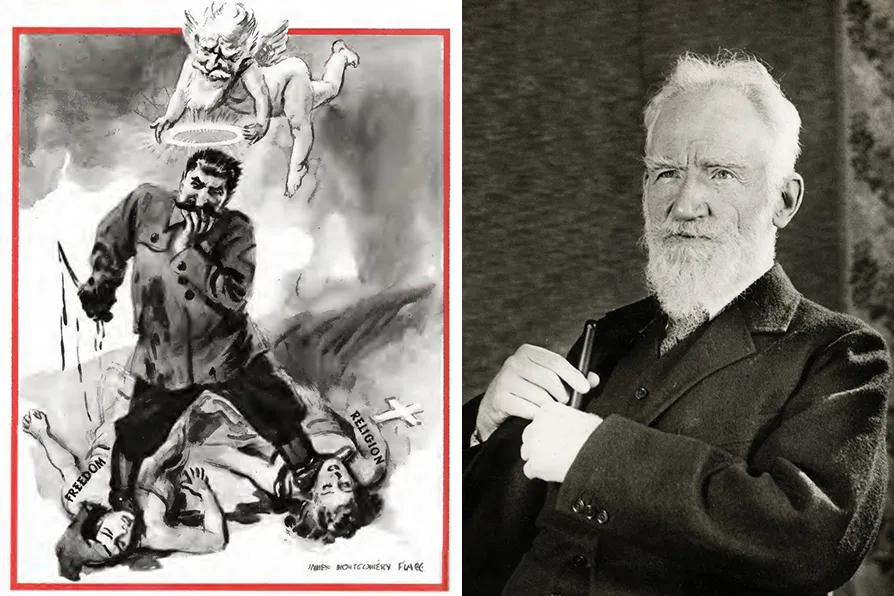
 CONTROVERSY: (L) George Bernard Shaw and Stalin, as caricatured by the US illustrator James Montgomery Flagg, 1941; (R) George Bernard Shaw, 1936 [Pics: Public Domain]

Re-releases from Iain Matthews, Quicksilver Messenger Service, and The Charlie Daniels Band
JAMIE BRITTON recommends that we all buy at least two copies of a remarkable book of poems
The bard joins the Carnival Against Fascism, which summer fun sends him down Memory Lane
FIONA O’CONNOR is bowled over by a stunning Welsh language drama
MARIA DUARTE and MICHAL BONCZA review Virginia Woolf’s Night & Day, Familiar Touch, Nino, and Toy Story 5
MATTHEW HAWKINS explores the initiatives proposed by HEALING ARTS SCOTLAND


“AN Irishman’s heart is nothing but his imagination,” observed George Bernard Shaw (GBS). Few writers have accumulated more honours than the extraordinary Dubliner. He won the Nobel Prize for Literature in 1925, received an Academy Award for the screenplay of Pygmalion, transformed modern drama, reshaped political debate in Britain and Ireland, and became one of the most quoted intellectuals of the 20th century. When he was not writing plays, he was helping to shape the socialist movement. When he was not contributing to the creation of the London School of Economics, he found time to meet Michael Collins and dine with Stalin.
Such was Shaw’s cultural influence that the word Shavian was coined to describe his works and ideas. His achievements are all the more remarkable because he possessed only a limited formal education. He never attended university and spent much of his youth educating himself through relentless reading. Shaw lived by his own maxim: “Life isn’t about finding yourself. Life is about creating yourself.”
Born in Dublin on 26 July 1856, less than a decade after An Gorta Mor (the “Great Hunger”), Shaw grew up in genteel poverty. His father, George Carr Shaw, was a struggling grain merchant whose alcoholism contributed to an unhappy home life. The young Bernard found sanctuary not in school, which he disliked, but in Dublin’s libraries, where he immersed himself in literature, politics, philosophy, economics and music. Such was his gratitude for public libraries that he later left a substantial portion of his estate to the National Library of Ireland.
In 1876, aged 20, Shaw moved to London. His first five novels were rejected by publishers and success seemed distant. Yet London exposed him to radical political ideas, and he became one of the leading voices of the Fabian Society. Unlike revolutionary socialists, the Fabians advocated gradual reform through democratic institutions. Shaw believed education was essential to social justice and argued that society could be improved through reasoned change. As he famously observed: “Progress is impossible without change, and those who cannot change their minds cannot change anything.”
By the 1890s Shaw had discovered his true vocation as a playwright. He believed drama should challenge society rather than merely entertain it. His early plays, including Widowers’ Houses and Mrs Warren’s Profession, shocked audiences by exposing slum landlordism, poverty and social hypocrisy. Through wit and argument, Shaw transformed the theatre into a forum for political and moral debate.
His greatest successes followed in the Edwardian era. Man and Superman (1903) combined comedy with serious discussion of social change and women’s equality, while Major Barbara (1905) explored the uneasy relationship between morality, religion and capitalism. Shaw’s plays entertained audiences while forcing them to confront uncomfortable truths about modern society.
His most famous work was Pygmalion (1913), the story of Professor Henry Higgins and Eliza Doolittle, a flower seller transformed through speech training. Beneath its humour lay a powerful critique of the British class system. The play became an international success and later inspired the musical My Fair Lady. In 1925 Shaw received the Nobel Prize for Literature, although he refused the prize money. In 1939 he won an Academy Award for the screenplay adaptation of Pygmalion, making him the only person to win both honours.
Ireland’s revolutionary decade also left a deep impression on Shaw. He sympathised with Irish demands for self-government and developed considerable respect for Michael Collins, whom he regarded as a pragmatic statesman. Shaw met Collins in Dublin just days before his assassination in August 1922. The encounter left a lasting impression, and Shaw later described Collins’s death as a tragedy for Ireland.
In 1946, when the Daily Worker became a co-op it issued a call for shareholders and, greatly to his credit, Shaw was the very first to come forward, and is the first official shareholder in this newspaper.
One of the most controversial episodes in Shaw’s life was his 1931 visit to the Soviet Union, where he met Joseph Stalin. Shaw emerged expressing admiration for aspects of Soviet society. Unsurprisingly this was regarded as a serious misjudgement by the capitalist press, and has remained, for them, a blemish on his reputation.
George Bernard Shaw died in 1950 at the age of 94. He witnessed Ireland’s journey from the aftermath of the Great Famine to independence and lived long enough to see the dawn of the atomic age. Yet he was never merely a witness to history; he helped shape it through his writing and political activism.
Perhaps Shaw’s greatest achievement was to make ideas entertaining. He transformed theatre into a place where ordinary audiences could engage with politics, philosophy and social justice. Despite his international fame, he remained unmistakably Irish: brilliant, argumentative and impossible to ignore. As Shaw himself reflected: “Irishness is not primarily a question of birth or blood or language; it is the condition of being involved in the Irish situation, and usually of being mauled by it.”
