KEVIN DONNELLY suggests that the task of transforming cultural spaces is far from over and that photography still has a key role to play


 Latest editorial
“Improvised music is the sound of the real world”
CHRIS SEARLE speaks to US saxophonist CAROLINE KRAABEL
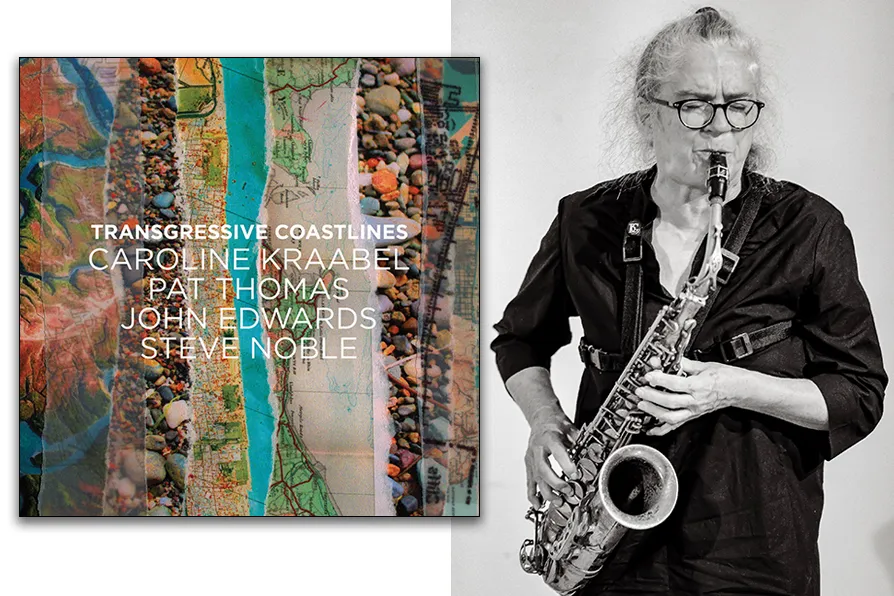 CHANNELLING REALITY: Saxophonist Caroline Kraabel [Pic: Cristina Marx]

RITA DI SANTO talks to Scottish-Irish filmmaker MARK COUSINS about his new series The Story of Documentary Film
ALAN MORRISON welcomes a new collection from the most imaginative and committed ecopoet of our time
CAL McBRIDE relishes the lyrical truth of an unstable identity in an over-tidy and conventional social realist treatment
New releases from Shearwater, Florry, and Navy Blue
CHRIS SEARLE welcomes a startling vision of contemporary Newport from a veteran photographer of the British working class
ANGUS REID recommends a very unusual documentary: a love story between two disillusioned journalists




CAROLINE KRAABEL is a freely improvising alto saxophonist, resident in south London, whose home city is Seattle. Her new album, titled Transgressive Coastlines, features three other outstanding exponents of the music: pianist Pat Thomas, bassist John Edwards and drummer Steve Noble, all nonpareils of their art.
When I ask her about the music they play, she is adamant that sonic escapism is the last thing on their minds. “Improvised music is the sound of the real world,” she avers. “We play against institutionalised music. Each of us wants every sound we make to be different to every other sound and to have the agency to empathise with our listeners, to try to open the doors of all our hearts and minds. That’s the glorious challenge of free improvisation.”
And those words are expressed with power and challenge in Transgressive Coastlines, from John Trice’s expressive sleeve design of strips of coast, beaches, pebbles, maps and estuaries, to the many phases of the quartet’s music.
“As we were about to record the album at The Vortex, it was April last year and we were thinking of the agony of Gaza and its blockaded coastline. Our track called Volcanic Tears tells of Palestine’s people erupting with grief and pain, and the final title Diamond Ashes reminded me of the great Andrej Wajda film trilogy of a similar name about anti-Nazi resistance by the Polish people, which I saw many, many years ago.”
I ask her about the quartet, and what prompted them towards free improvisation?
“I think, because we’re all around the same age, around 60, that it was punk that had a big influence. The so-called ugly, stupid-sounding music that we made totally by ourselves in those days. I don’t think we’ve ever lost that, and audiences of the same generation have never lost it either.” It was as if she were attesting to the reality behind Monk’s epochal tune, Ugly Beauty.
Caroline has recently returned from a long stay in her home city. I ask her how people there were dealing with Trumpery and its racist and imperial exploits, particularly musicians. “I stayed in the Seattle area,” she says. “Many people there are frozen in trauma, and bludgeoned by every government action that makes sure they are atomised and rendered passively pessimistic, with young people through poor education becoming virtually functionally illiterate.
“But there is resistance too. I took part in an anti-Ice benefit, and musicians are very much a part of all that — and the constant picketing outside of the Ice prison in Tacoma, to the south of Seattle, where detainees from all over the country are incarcerated.”
But back to Transgressive Coastlines. Edwards’s plucked bass, shimmering and whining, Noble’s soft drums, Thomas’s chimes and Kraabel’s spurts of saxophone breath, whistles and grunts collectively begin Dark Rainbow, the album’s opening track. It is as if each musician is striving for connection and release from solitariness, but knowing they will find it in the music. Kraabel’s horn suspirations keep hope alive as Thomas seems to be throwing his notes across the floor before he begins a confabulation with Kraabel, while Noble, playing all over his percussion, brings the palaver home.
Thomas’s deep and defiant keys and Kraabel’s outcry, like an excited fowl, find their opening exchanges in Volcanic Tears, a long colloquy of lamentation. Edwards’s bow-work, Thomas’s elegiac phrases and Noble’s ringing cymbals signal grief alongside Kraabel’s wounded voice-sounds, a foursome commentary on the still-peopled Pompeii-streets of stricken Gaza on every night’s television screens.
The final track is Diamond Ashes. Kraabel’s exhalations keep the music just alive before Thomas’s fulsome, unwavering notes plough through the track’s beginning, with Edwards digging for freedom, Noble’s drums growing in power and Kraabel’s horn unfettered and released. It’s an ensemble sound you will only ever hear once, for it is different every time — except if you have the record, for that is the only way you will ever hear it again.
Such is the abiding truth of free improvisation.
Transgressive Coastlines is released by Shrike Records

Similar stories
STEVE JOHNSON speaks to London singer/songwriter MADDY CARTY
CHRIS SEARLE recommends a new album featuring Pat Thomas and Ahmed, and marvels at the tempestuous power of a live performance
SUSAN DARLINGTON swoons in the presence of a magnetic frontman
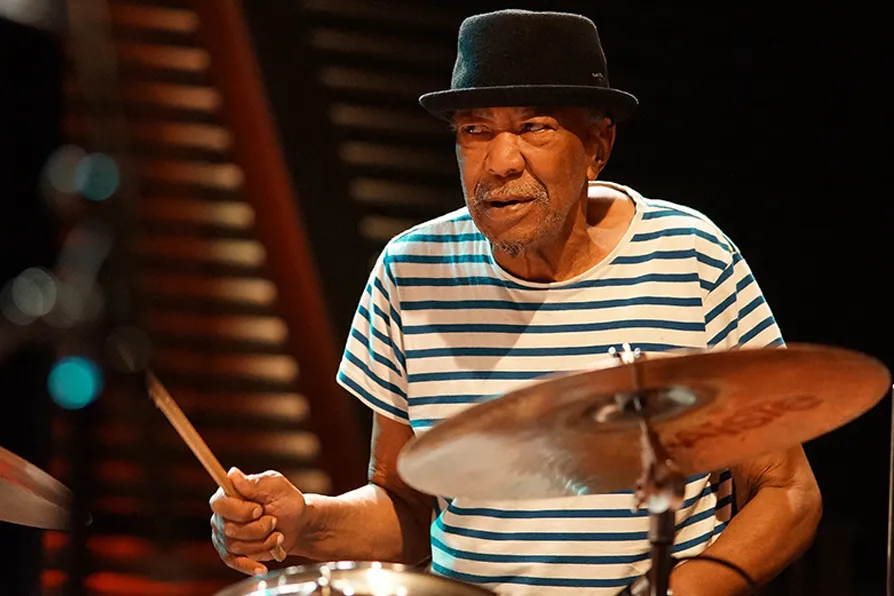
CHRIS SEARLE pays tribute to the late South African percussionist, Louis Moholo-Moholo