

 Latest editorial
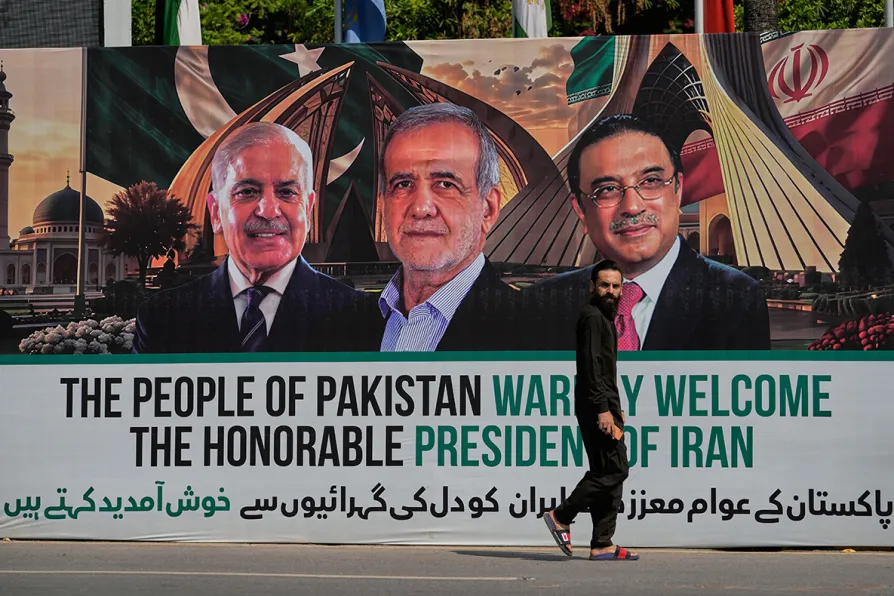 A man walks past a welcoming billboard featuring Iranian President Masoud Pezeshkian (centre) with Pakistan President Asif Ali Zardari (right) and Shehbaz Sharif along a roadside in Islamabad, Pakistan, June 23, 2026




IRANIAN President Masoud Pezeshkian travelled to Pakistan today for talks with officials who have been mediating in negotiations between Tehran and Washington on a permanent end to the Iran war.
Technical teams are working on details of the deal, following high-level negotiations in Switzerland on Monday that were led by US Vice-President JD Vance and Iranian parliamentary Speaker Mohammad Bagher Qalibaf.
Mr Vance had said that the negotiations in Switzerland had included an agreement for International Atomic Energy Agency inspectors to visit Iranian nuclear sites.
But Iranian Foreign Ministry spokesperson Esmail Baghaei told reporters in Tehran today that no visits have been scheduled to the facilities previously bombed by the US.
During initial talks, marking the start of a 60-day diplomatic process seeking a permanent deal to end the illegal and unprovoked war unleashed by the US and Israel on February 28, Tehran and Washington agreed to create a “deconfliction cell” to address the fighting in Lebanon between Israel and the Iranian-backed Hezbollah resistance movement.
The US said negotiators had also discussed “mechanisms” to ensure that the Strait of Hormuz remains open.
Ahead of his meetings in Islamabad, Mr Pezeshkian cautioned that “the effectiveness of the talks depends on full commitment to the agreed obligations and their precise implementation.
“Progress on this path will be measured by practical adherence to accepted responsibilities,” he wrote on social media.
Iran suggested that the ongoing technical talks in Switzerland had led to the creation of specific negotiation groups, focused on issues such as sanctions relief, nuclear matters, reconstruction and monitoring, according to a report by the IRNA news agency.
It quoted Deputy Foreign Minister Kazem Gharibabadi, who is leading the technical talks, as saying that the countries involved also formed a contact mechanism to deal with ship movements through the Strait of Hormuz and the fighting in Lebanon.
Mediators Pakistan and Qatar said the deconfliction cell would include the Lebanese government and would “ensure the adherence of the termination of military operations in Lebanon.”
But Israeli Prime Minister Benjamin Netanyahu said on Monday that his military still had “full freedom of action to thwart any direct or emerging threat to them or to the residents of the north.”
Neither Israel nor Hezbollah are signatories to the US-Iran deal and Mr Netanyahu has vowed to maintain his illegal occupation of southern Lebanon until any threat to Israel is eliminated.
Hezbollah has refused to halt attacks unless Israel commits to withdrawing.
