MARIA DUARTE defends a solid, late-career Spielberg conspiracy flick that calls for empathy in a hostile world


 Latest editorial
Puerto Rico: the long struggle against US imperialism
ANDREW MURRAY welcomes a fascinating account of the struggle in Puerto Rico for democracy and independence
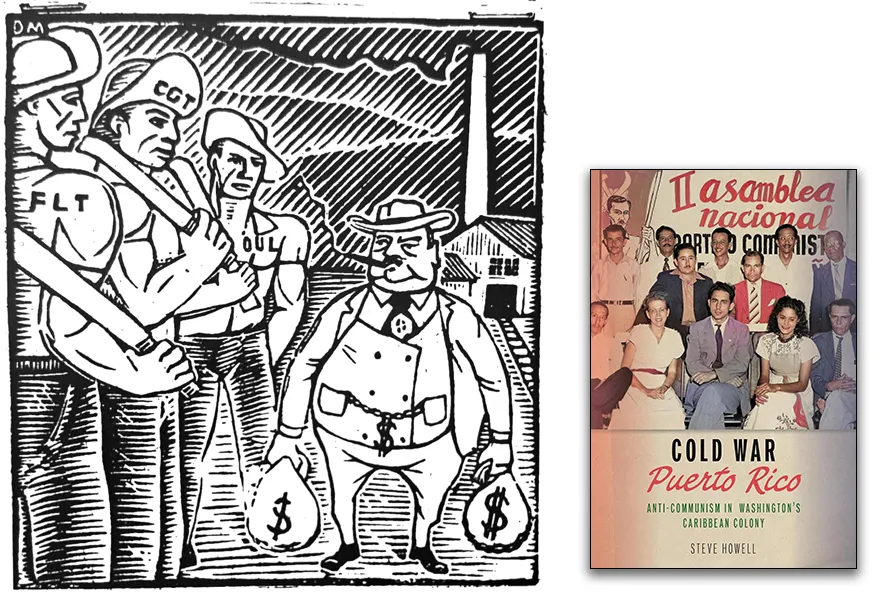 Cartoon by Brandon Howell, under the pen-name “Diego Munoz”, September 30 1944, depicting the hostile reception given to US capital by the FLT (Free Federation of Workers) and the CGT (General Confederation of Workers) [Pic Courtesy of Steve Howell]
MARIA DUARTE, SCOTT ALSWORTH, ANDY HEDGECOCK and ANGUS REID review The Fall of Sir Douglas Weatherford, Detective Conan: Fallen Angel of the Highway, Time and Water, and Strictly Ballroom
STEVE JOHNSON recommends a beautiful album of songs that celebrate summer, from May Day onwards
New releases from Joe Wilkes, Honey and the Bear, and Hannah James and Toby Kuhn
Given the power of the live experience, MIK SABIERS recommends Jon Spencer’s new album
Reviews of T.P. Orchestre Poly-Rythmo, Tamikrest, and Dub Colossus




Cold War Puerto Rico: Anti-Communism in Washington’s Caribbean Colony
Steve Howell, University of Massachusetts Press, £26.99
PUERTO RICO is a forgotten colony – a US possession ultimately governed from Washington but with none of the rights that come from statehood, little influence over those who rule it and its people frequently a butt of racism, not least from the incumbent president.
Seeing control of the island as a strategic necessity — it is still a major Pentagon hub — the US has long sought to ensure that nothing happens to give Puerto Rico genuine independence or its people meaningful self-government. Steve Howell’s book details those protracted efforts during the cold war, mobilised under the banner of anti-communism.
The account is the more vivid because it is also a family history – Howell’s father, Brandon, was a key player in the communist and progressive movement in Puerto Rico, who was monitored by the FBI for years after he had moved to Britain.
Howell himself played a key role in running Labour’s 2017 general election campaign and is a lifelong socialist activist, as well as the founder of a successful PR business.
His book deservedly retrieves Puerto Rico and its people from historical obscurity and foregrounds the struggle of its people for democracy and independence. Fast-paced and well constructed, it skilfully blends the political and personal narratives, using the latter to illuminate the former.
As McCarthyism gathered steam in cold war Washington, with its tactics of witch-hunt, surveillance and repression, Puerto Rico and Brandon Howell were caught in its toils. The purpose was both anti-communism and colonial control.
Howell senior was a radical cartoonist working in San Juan, Puerto Rico’s capital, which was more than enough to attract the FBI’s attentions. His son has used access to his father’s files held at the bureau to tell the story.
Successive chapters describe the “red scare” atmosphere and how it was translated into Puerto Rican politics, seeking out local collaborators while marginalising (or worse) those demanding independence.
Driven into exile, Brandon Howell remained on the FBI “watch list,” with the book detailing the extent of that surveillance in the US and in Britain, an extraordinary expenditure of energy and resources – the more so when one considers that tens of thousands at least were subject to such minute scrutiny over decades.
In Brandon Howell’s case it included securing a statement from his estranged first wife, the personal most certainly being political for notorious FBI boss J Edgar Hoover.
The struggle grew sharper after 1954, when independence fighters from Puerto Rico attacked the US congress, leading to a wave of arrests of entirely unrelated activists.
Howell also details the humiliating visit of the House UnAmerican Activities Committee (HUAC) to the island in 1959, when Washington’s inquisitors met the united resistance of Puerto Rican politicians and people alike, insisting that the committee had no jurisdiction. There are certainly contemporary lessons to be learned in terms of united mass resistance to state coercion.
In the face of this setback, Hoover increasingly turned to covert action in Puerto Rico, as he did on a far broader scale across the US in the face of the radical upsurge of the 1960s, expressed in the anti-war and civil rights movements above all.
The story is valuable in its exposure of the links between anti-communism and colonial control, something Britain also practised at the time in Guyana, Malaya, Iran and elsewhere.
Puerto Rico’s status has little changed since the period recounted here. Control of the island remains a US strategic imperative. Periodic demands for US statehood or independence have gone nowhere.
Howell’s book fills out an important part of anti-imperialist and democratic history. It is a product of deep research, firm political understanding and clear writing, as well as filial affection. May it stir interest in, and support for, the overlooked struggles of the Puerto Rican people.
