

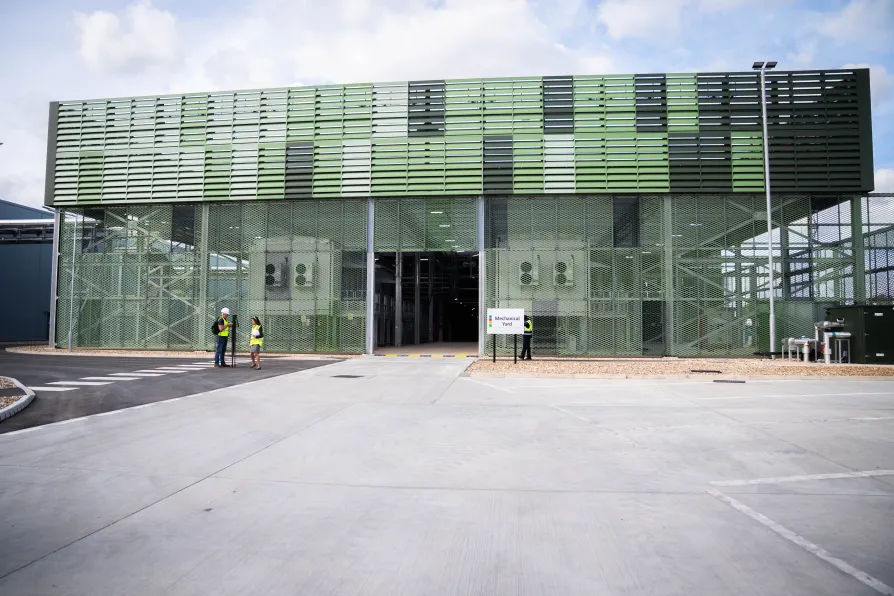
 A general view of Google's new data centre in Waltham Cross, Hertfordshire





THE case for a controversial £8.2 billion hyperscale AI data centre in Lanarkshire is built on “bunk,” an investigation has found.
In January, Prime Minister Sir Keir Starmer unveiled a plan to turn the area once synonymous with Scotland’s heavy industry into an “AI growth zone,” with £5 million of state and £8.2bn of private-sector investment.
DataVita and CoreWeave International were to lead the charge, creating 3,400 jobs, but claims that enough renewable power could be generated onsite to meet its one gigawatt energy needs — the UK’s largest onshore windfarm, Whitelee, only produces two-thirds of that — have been thrown into doubt.
A Guardian investigation found little evidence that developers could deliver on claims to generate 400 megawatts of solar power and 800MW of wind, potentially making it reliant on an already overwhelmed national grid it could face a 10 year wait to connect to.
Both developer and government appear to have been long aware of this, with First Minister John Swinney writing to assure DataVita managing director Danny Quinn in February: “I recognise that power provision remains a key issue and we will continue to engage with the UK government and relevant partners to secure timely grid connections that enable and support the development to proceed at pace.”
The revelations only fuel the calls for greater transparency championed by Action to Protect Rural Scotland.
Director Kat Jones warned: “There is a wave of applications for hyperscale AI data centres coming to Scotland and they all say they’re going to use renewable energy.
“We have examined DataVita’s plans to build renewables to power their 500MW data centre and found them wanting.
“Even if they could build the amount of energy infrastructure they say they will, it would cover 100 kilometres squared but only provide for half their energy requirements on average.”
An engineering consultancy analyst who has advised several AI growth zone projects told the Guardian: “There doesn’t seem to be appropriate scrutiny, public or otherwise, on these nationally significant projects.
“The figures and designs behind many schemes are at best indicative, and at worst complete bunk.”
DataVita claimed the development’s “energy strategy is based on new renewable generation, private-wire infrastructure and intelligent connection to Scotland’s electricity system,” while a UK government spokesperson insisted: “The whole government is determined to create the right conditions for investment in the UK’s AI and datacentre infrastructure with Lanarkshire set to be the first AI growth zone in the country to see hardware rolled out.”




In the second and final part of his article MIKE SCOTT posits that if we don’t control AI while we’ve got the chance, we could be signing the death warrant for our children and grandchildren

Lawyers to challenge approval of data centre in Britain that ‘pollutes on the scale of an international airport’