MARY DAVIS says the centrality of the Jewish community and the Communist Party to anti-fascism in the 1930s is too often overlooked on the left


Should socialists support a universal basic income – or universal basic services?
Calls for a Universal Basic Income are a red herring, argues the Full Marx editorial team — socialists should fight for Universal Basic Services

 A CASE FOR UBS: A former soldier down on his luck forced into homelessness / Pic: Allan Warren/CC
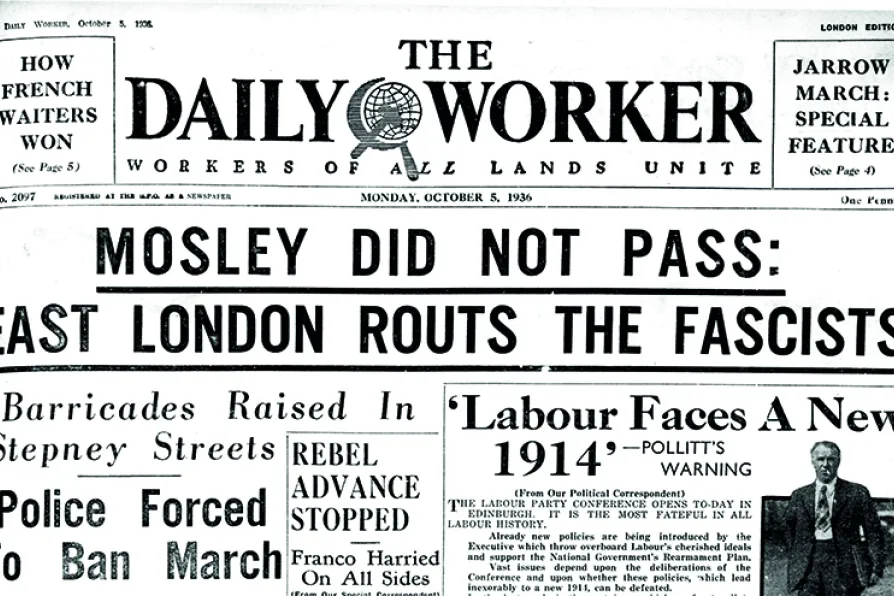
A 1936 confrontation with Mosley’s BUF became part of a wider international struggle, with local activists later joining the fight against fascism in the Spanish civil war. TONY FOX tells the story ahead of a 90th anniversary commemoration event
GEORGE WHITE explains why Unite’s Lancashire area activists committee believes co-ordinated recruitment in an area defined by particular kinds of employment and linked by a major transport artery could provide a model for organising the unorganised
Voters have delivered a stay of execution for Labour and exposed limits to Reform’s advance. But will Burnham offer a political alternative rather than just a different face at the top, asks ANDREW MURRAY
SEVIM DAGDELEN warns that Germany’s military resurgence and revival of old hostilities towards Russia have dangerous implications for Europe and beyond




UBI — a “universal” or “unconditional” basic income is typically defined as a regular cash payment, made to everyone — without reservation; with no means-testing or requirement to work or to contribute in any other way to society.
The first known proposal for a UBI is sometimes attributed to the English Radical Thomas Spence in his essay The Rights of Infants in 1797.
Spence was a member of the London Corresponding Society — one of their meeting places was a pub, The Bell Tavern on Exeter Street, just off the Strand and very close to what is now the Marx Memorial Library.
In 1816 he was involved in an attempt at insurrection launched from Spa Fields (also adjacent to the Library) which presaged the Peterloo Massacre a few years later.
Spence’s UBI proposal was not restricted to children and was unrelated to need.
Today partial “basic income” arrangements exist — in Britain and other countries — in the form of child and disability benefits and to some degree in a state pension.
All socialists support these and press for their extension. All are constantly under attack — witness issues over the “two-child” benefit, the raising of the pension age and Reform’s proposals to transform the NHS into a two-tier voucher scheme with private healthcare.
But these are not “universal” benefits. UBI involves a payment to “everyone,” irrespective of age, gender, wealth or other income.
Most proposals today for an UBI assume that it will be funded through taxation, whether a “claw back” tax on high earners or net wealth or consumption (including “sin” taxes — on alcohol, fuel, tobacco).
Some of its most influential early proponents include neoliberal economists such as Milton Friedman and Friedrich Hayek. UBI is typically framed as redistribution within a “market” economy, not as any socialist restructuring of ownership.
Beyond arguments related to welfare, some argue that UBI will aid the survival of capitalism, through encouraging entrepreneurship (as in Margaret Thatcher’s Enterprise Allowance Scheme) or facilitating adaptation to AI and automated production.
At a more mundane level, proposals for UBI (some of them partially manifest in experiments such as Universal Credit) include merging overlapping benefits, eliminating bureaucratic inefficiencies and the administrative costs of means-tests and compliance systems; all politically easier to pitch as “simplifying” rather than “increasing” public spending.
Sometimes UBI is coupled with other proposals. US economist and Nobel laureate Friedman, the founder of monetarism and a major influence on Ronald Reagan and Thatcher argued for a negative income tax (UBI at the front end, with a higher tax rate on earnings to pay for it).
Some de-growth theorists propose UBI paired with limits on wealth accumulation.
Almost all mainstream UBI proposals assume a fully capitalist economy with private ownership of the “means of production” although some on the left advocate UBI to reduce the pressure to accept “bullshit jobs:” others argue that it could be part of a transition to a communist — or “communalist” — society.
The Labour Party under the leadership of Jeremy Corbyn included a commitment to conduct a pilot study of UBI in its 2019 general election manifesto, with trials to address poverty in areas such as Liverpool and Sheffield.
During the 2020 Covid pandemic in 2020, many opposition politicians called for an “emergency UBI.”
Subsequently UBI has fallen off the Labour agenda.
However, the Green Party continues to argue for “the introduction of a Universal Basic Income that will give everybody the security to start a business, study, train or just live their life in dignity.”
Support on the left for UBI reveals a fundamental misunderstanding of the working of capitalism. UBI ignores how value is created (by human labour) how much of it is appropriated (by capital as “surplus value,” realised as profit) and accumulated (whether in machinery or money form, as “dead labour” to facilitate the extraction of more value and profit).
Within capitalism, wages, including the “social wage,” are constantly under attack and tend to the minimum deemed socially necessary to support the maintenance and reproduction of labour power.
At its very simplest, levels of UBI payment could never be more than would permit those without other income to survive; food and clothing, leaving aside the question of rent. For low wage earners it might supplement — and provide an excuse for further attacks on — other income.
UBI is individualist. It has a certain superficial attraction offering “money to spend.” For the well-off it would merely provide a free perk to spend on luxuries — including private health or childcare, further undermining public provision.
Perhaps most importantly UBI would undermine demands for UBS — the provision of free universal and unconditional basic services from healthcare, education, welfare and other public provision from community centres and libraries to sports and recreational facilities, public parks, transport infrastructure and environmental protection.
A recent survey by the National Education Union (NEU), reported in this paper, shows that almost nine in every 10 parents support free school meals for all primary school pupils in England.
This is greater than the third who have had to cut their food bills due to cost-of-living pressures and more than the half of all parents who said the proposal would have a positive impact on their family finances — indicating significant support for it in principle.
UBI fits well with the ongoing commodification of hard-won public services. It is neither organisationally nor ideologically in conflict with capitalism and hence also more vulnerable to erosion.
Is it just a coincidence that arguments for UBI should coincide with proposals (such as from Conservative ex-health Minister Sajid Javid) to introduce a charge for GP appointments? A slippery slope.
UBI is at best a red herring, a way of papering over the cracks for the poorest and — if it is to be truly “universal” for those who can survive quite happily without it, a little extra pocket money.
More likely it would be used as cover for yet further cuts — not just to welfare but to public services in general.
This was something recognised a century and a half ago. “From each according to their ability, to each according to their needs” is a slogan popularised by Karl Marx which recognises that everyone who can do so, should make some contribution to society — and everyone should have free access to the goods and services that are collectively produced.
UBS is collective. It provides a focus for united action to protect what we have and to extend it further.
UBI was described by a writer to this paper as “snake oil.” Marx and Engels would have agreed.
In a fully socialist society where we all had access to what we “needed” (and our wants were related to need and inclination rather than confected by advertisers for profit) “income” would not be the prerequisite for consumption.
In the meantime, the struggle to protect and extend UBS — basic services for everyone is a major challenge facing us all.
The Marx Memorial Library’s rich programme of events and courses can be found on its website. Find earlier Q&As (this is number 132) here.
