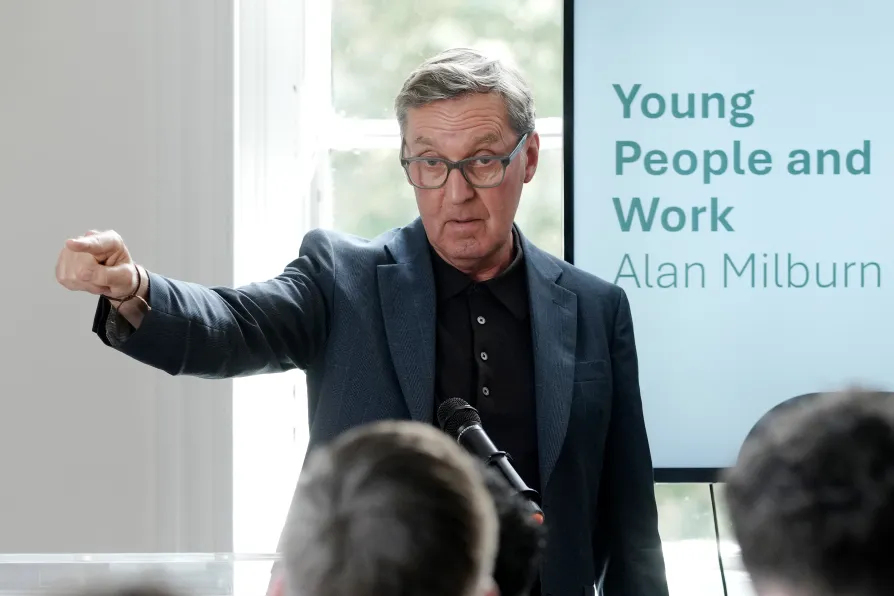
The Milburn review presents itself as a plan to help young people into work, but Dr DYLAN MURPHY argues it is laying the groundwork for a harsher benefits regime


 Latest editorial
Trade unionists learn about Italian partisans and anti-fascism in poignant Bologna trip
Trade unionists from Liverpool and Greater Manchester travelled to Bologna and the Monte Sole region to find out about the struggle against fascism and Nazi occupation. ROB MacDONALD reports
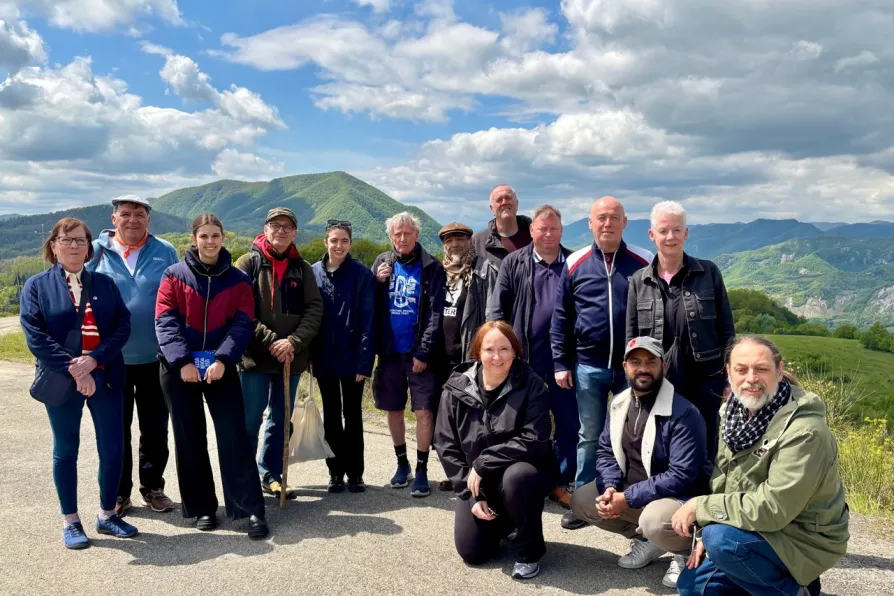 The North West Trade Union International Committee group in the Monte Sole area south of Bologna with Italian guides Valentina Catone and Andrea Marchi (third and fourth from left) and Juri Guidi (kneeling, right)
Campaigners from across the continent will gather in Brussels on June 14 to oppose Europe’s accelerating militarisation and cuts to public services, write MAGGIE SIMPSON and BOB ORAM of No Cold War Britain
National co-ordinator for General Strike 100, HENRY FOWLER, continues his nationwide tour of partner organisations by visiting the Modern Records Centre at Warwick University
GEOFF BOTTOMS recalls meeting Fidel Castro in the ’90s after joining a Pastors for Peace caravan to Cuba, and reflects on how international support is still vital to help the island withstand economic warfare
The Ivors Academy’s hike in entry fees could turn this respected peer-assessed event into an exclusive preserve for those wealthy enough to compete, warns BEN LUNN
Peter Murrell’s weakness for the allure of prestige goods is symptomatic of modern consumer culture, says MATT KERR




A GROUP of trade unionists from north-west England visited Bologna to learn about Italian resistance to Mussolini’s fascist state and Nazi occupation in the second world war. And new relationships are being developed with an Italian organisation involved with various events in Britain too.
The North West Trade Union International Committee had guided tours of Bologna and nearby rural areas with the Associazione Nazionale Partigiana d’Italia (Anpi).
Steve Farley and Martin Kelsey arranged the tour with Anpi UK & Ireland’s Simone Rossi, who is based in London; and Anpi members Anna Cocchi and Juri Guidi in Bologna. Members of the French CGT joined the Bologna visit too.
Originally, Anpi was as an Italian partisans’ association but today it has branches globally and members including young people of many nationalities. It raises awareness of Italian anti-fascist history, campaigns for democracy and engages with current affairs.
The trade union group from Liverpool and Greater Manchester took part in a commemoration parade in Bologna to mark the city’s liberation in 1945 and visited ruined villages in hill country to the south, where Nazi troops massacred hundreds of Italian civilians.
They also heard about Italy’s post-war steps towards democracy including its 1946 constitutional referendum, leading to a republic, and Italian women getting the vote in 1946. This year is the 80th anniversary of those events.
Italy’s experiences of dictatorships and its tumultuous history through the 1920s, ’30s and ’40s arguably need to be more widely understood in Britain. Italian progressive movements were driven underground or into exile, operating under the most difficult circumstances over 20 years.
Italy’s own fascist regime and its later support for Nazi Germany had terrible consequences, which an article of this length cannot cover. But, importantly, Italian resistance existed and evolved as events unfolded inside and outside Italy.
Factors arguably included early Italian socialist and communist divisions, the Communist International’s move to popular front tactics in the 1930s; the Spanish civil war and experience of Italian International Brigade volunteers who later became partisans in Italy, second world war events and the formation of Italy’s National Liberation Committee (CLN) which co-ordinated partisans.
Northern Italy became especially significant for resistance after Italy was divided in 1943. That happened after Mussolini was dismissed and Italy’s king agreed an armistice with the Allies. But Mussolini was rescued by Hitler and made head of a northern puppet state. German forces occupied northern Italy and built a heavily fortified defences, as the Allies, including British troops, advanced through southern Italy.
The resistance included men, women and children who showed extraordinary bravery in different roles. Partisans came from various nations including Italy, the Soviet Union and Britain
Bologna was liberated on April 21 1945. Then on April 25, a general insurrection was declared by the National Liberation Committee for Northern Italy (CLNAI). That led to Nazi surrenders in Milan and Turin, and Mussolini was captured and shot by partisans. April 25 is now a national Italian bank holiday.
Bologna
In Bologna, the British group joined a rally to mark its liberation. Visitors met local Anpi members, trade unions and other groups to parade with banners and flags, with Bolognese veterans at the front. The rally went to the Piazza del Nettuno, where a memorial has thousands of photographs of people in Bologna’s resistance. Formal commemorations were held there.
Farley, of the north-west group, said: “We were invited to help carry flags of partisan groups. We also presented Anpi’s Anna Cocchi with a replica flag of the International Brigade’s British Battalion, which she was delighted with. Anna presented us with an Anpi Bologna flag, which we have added to a collection of international memorabilia at the PCS union offices in Jack Jones House, Liverpool.
“A second British Battalion flag was presented to Juri Guidi and we gave International Brigade badges to various Italian comrades.
“Later, our group had a guided radical tour of central Bologna by Simona Salustri of the University of Modena and Reggio Emilia. She is a resistance expert. A young interpretor, Valentina Catone, played a key role, assisting with visitors’ questions and greatly enhancing the tours.”
Marzabotto
On day two, the group travelled to villages and hamlets around Monte Sole and Marzabotto.
The first location visited was the Spazio Stella Rossa, a small, beautiful museum about the Stella Rossa partisans’ brigade. Housed in a converted railway building at Monzuno Vado rail station, it includes a library, lecture hall and displays.
The day was led by Andrea Marchi of the Comitato Regionale per le Onoranze ai Caduti di Marzabotto, a regional committee honouring the victims. Again, interpretor Valentina Catone translated.
Railways and roads were vital for the Nazi occupation and were targeted by the partisans. But in September 1943, Waffen SS troops systematically killed hundred of civilians around Marzabotto, aiming to terrorise the Italian population and destroy resistance support. Today, the area has special status and is called the Parco Storico di Monte Sole.
The British group visited massacre sites including a church and church yard, and former hamlets destroyed by the Nazis. They also held a period of silence to remember the victims. The Monte Sole area includes information panels at different hamlets, and an education centre and cafe in addition to the Spazio Stella Rossa.
Farley added: “Overall, the trip was really informative and highlighted important events. Everyone was very positive about the experience and we were made very welcome by Anpi comrades. We are now actively considering future trips.”
In Britain this spring, Anpi has been involved in events with supporters in London, Salford, Manchester, Stockton on Tees and Glasgow. Anpi is keen to engage widely with British organisations. Talks, film screenings and anti-fascist pasta meals are among further activities planned.
In Liverpool on Saturday July 25, the North West Trade Union International Committee is holding two international solidarity events.
The first is at the Unite office, Jack Jones House, at 12 noon, called Internationalism & Workers Solidarity. Speakers include Simone Rossi of Anpi, Claire Moreau of the French CGT and Kevan Nelson of the north west group. The Spanish CCCO union and Fundacion Abogadas de Atocha will be represented too. It commemorates the assassination by Spanish neofascists of people working for a labour movement law firm in 1977 in Madrid and contemporary issues.
The second July 25 event is a Spanish civil war commemoration at The Casa, Hope Street, Liverpool, at 3.30pm. Speakers include authors Paul Preston, Helen Graham and a CCCO/Atocha foundation representative.
