

 Latest editorial
Campaigners and MPs blast Court of Appeal’s decision to uphold Palestine Action ban
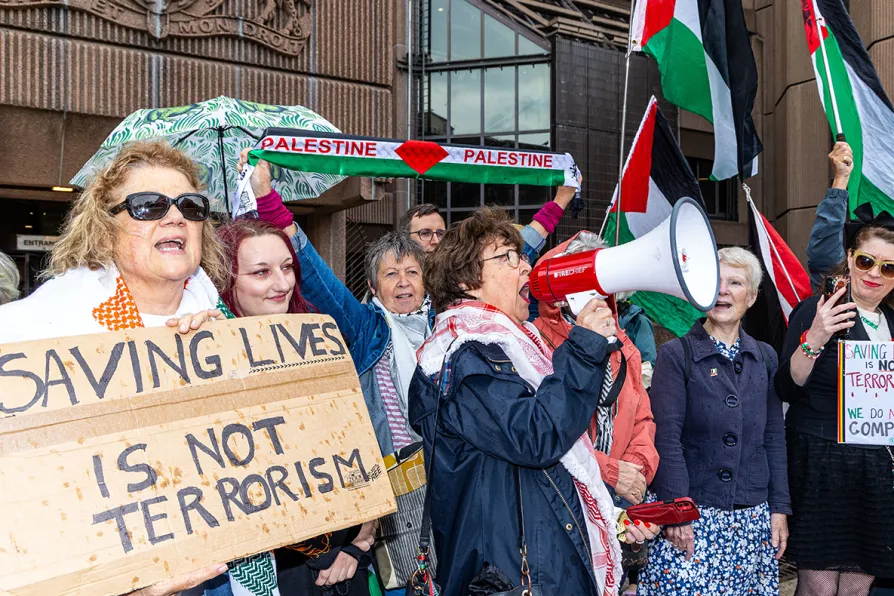 Protesters outside the Law Courts in Liverpool where they gathered to listen to the judgement regarding the appeal of the proscribing of Palestine Action, June 15, 2026 [Pic: Neil Terry]


CAMPAIGNERS and MPs called on ministers to withdraw the proscription of Palestine Action following the Court of Appeal’s decision to uphold the ban, branding the decision an attack on the “very foundations of democracy.”
The government won its appeal today as five judges ruled the Homes Office’s July 2025 decision to proscribe the direct action group was lawful.
Lady Chief Justice Baroness Carr said last year’s ban under the Terrorism Act 2000 was a “justified and a proportionate” interference on freedom of expression rights, overturning a February ruling from the High Court which was set to quash the proscription.
Since July 5 last year, the ban has attracted widespread condemnation as well as a civil disobedience campaign led by Defend Our Juries, which has seen more than 3,000 people arrested.
Palestine Action’s proscription under terror laws means that being a member of, or showing support for, the group is an offence punishable by up to 14 years in prison.
Most of the arrests since proscription were for holding placards saying “I oppose genocide, I support Palestine Action.”
The Court of Appeal’s panel of five judges included Lady Chief Justice Sue Carr and Master of the Rolls Geoffrey Vos.
In their summary of the decision, Lady Chief Justice deemed comparisons of Palestine Action with the Suffragettes to be “seriously flawed,” arguing that the Suffragettes operated “transparently” while the banned group tried to “avoid the detection and prosecution of those using violence to destroy the property of third parties.”
Palestine Action co-founder Huda Ammori, who brought forward the case against the Home Office’s proscription, said she was undeterred by today’s decision.
She said she will “fight proscription all the way” to the Supreme Court and European Court of Human Rights with the hope of having overturned “one of the most extreme attacks on free speech and the right to protest in modern British history.”
Former Labour leader Jeremy Corbyn called the decision “a travesty of justice,” adding: “One by one, the very foundations of our democracy are being destroyed — all to oil the wheels of British complicity in genocide.
“Our government has participated in the mass murder of Palestinians. That is the real crime, and we must bring about justice.”
And former shadow chancellor John McDonnell called on Parliament to urgently reverse the decision “before we see large numbers of elderly people in particular being dragged before our courts.”
Scottish Greens justice spokeswoman Maggie Chapman condemned the decision, calling it a “devastating blow to free speech and the right to protest.”
She added that the government and the courts “criminalised conscience and sent a chilling message to anyone willing to speak out against injustice.”
Stop the War Coalition convener Lindsey German agreed and highlighted that the ruling came only a few days after the jailing of the Filton 4 activists as terrorists last Friday.
These decisions, Ms German said, confirm “the stitch-up by the Establishment against the right to protest against a genocide.
“The judge’s repeated description in his review of Elbit Systems producing weapons used in an active genocide as ‘lawful business’ and of Palestine Action as ‘violent’ for disrupting it says everything we already know about the British state.”
She called for today’s decision to be “urgently and openly debated by MPs.”
Cage International head of public advocacy Anas Mustapha said the ruling was a reminder of “what these powers are for.
“They are not safeguards against violence, they are authoritarian tools for crushing dissent.
“Thousands of people, including pensioners, now continue to live under threat of prosecution for opposing Britain’s role in a genocide.
“That is the reality this judgement protects. No ruling from any court is going to convince people that their conscience is wrong, and no amount of legislation will make support for Palestine disappear.”
He added: “The only sustainable outcome is the abolition of these laws in their entirety.”
Amnesty International UK’s legal programme director Tom Southerden described the ban as “a grave misuse of sweeping counter-terrorism powers with serious consequences for human rights.
“It is fundamentally disproportionate to treat direct-action protest as terrorism.
“The government must withdraw the proscription and begin reversing years of attacks on our right to demonstrate — one of the most effective tools we have to hold those in power to account.”
