When the ravages of Alzheimer’s leave an elderly woman marooned in painful memories of October 1950, her grandchild comes up with a creative strategy.


 Latest editorial
The unending scandal of Ireland’s Magdalen laundries
SUE TURNER is compelled by a history that shows how far a country can turn in on itself to collude with abuses of power
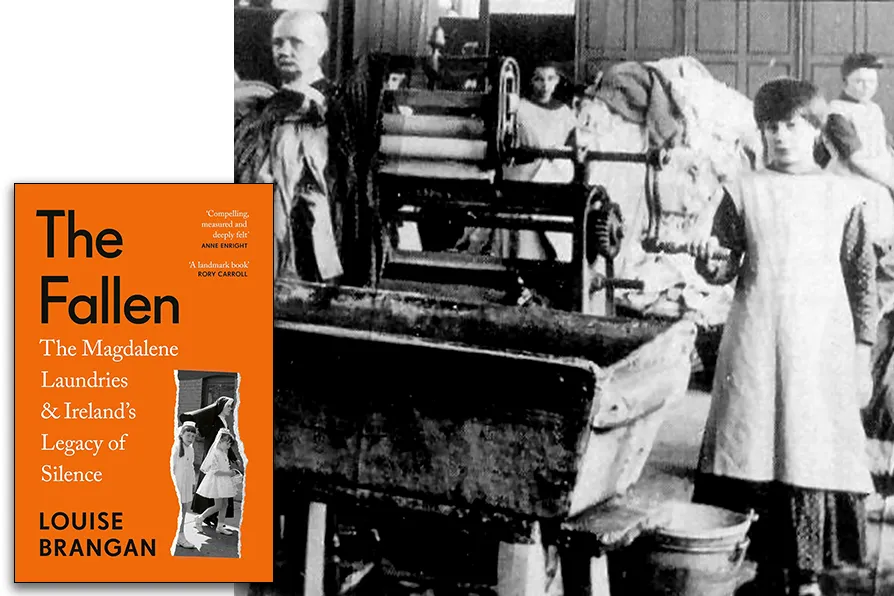 Unidentified Magdalen Laundry in Ireland, c. early 20th century. [Pic: Public Domain]
New releases from Simone White, Brass Funkeys, and Souad Massi
RON JACOBS is persuaded by the parallel drawn between Charles Manson and Donald Trump
In this comparison of Britain pre- and post Thatcher, WILL POMORE applauds the analysis, but distrusts the solutions offered
MARIA DUARTE defends a solid, late-career Spielberg conspiracy flick that calls for empathy in a hostile world




The Fallen: The Magdalene Laundries and Ireland’s Legacy of Silence
Louise Brangan, The Bodley Head, £22
THE 10 Magdalene Laundries were the most severe form of correctional institutions in Ireland from the establishment of the Free State in 1922 to their final closure in 1996.
There were also mother and baby homes for illegitimate births, and industrial schools for orphans and neglected or illegitimate children, all claiming to operate from the highest motives but overseeing a system drenched in humiliation, cruelty and abuse.
To understand why the Laundries were established and how they functioned, Brangan says, we need to understand the political and cultural ideas that framed Irish society.
In order to counteract modern ideas in fashion, music and other pleasures after World War I, the Catholic Church stated that the future of the country was bound up with “the dignity and purity of the women of Ireland.” The Church argued that growing poverty was the result of a lack of faith and that “imported evil culture” must be eradicated.
The government established a Committee on Evil Literature; authors such as Balzac, Hesse, Kazantzakis and Edna O’Brien were banned, books were burned, and the Protestant head of Mayo’s libraries was replaced.
In order to clear impure thoughts from society “morally degenerate and mentally deficient women” were removed from circulation by force. The definition of a “fallen woman” expanded to include not only women who had extra-marital sex or bore illegitimate children, but any woman who “shattered the ideals of womanhood by having foreign tastes and lacking moral fibre.” From 1922, 10,000 women at the very least were incarcerated in the Laundries which were run by four orders of nuns. These women performed heavy and often dangerous laundry work for no pay and suffered sarcasm, insults and violent abuse.
Their lives were constantly overseen by the nuns who led them in endless prayer throughout the working day. There were no friendships made, no speaking allowed, no clocks and no free time except for a silent walk round the yard before bed. Sundays were for knitting and praying. Even the furniture in the refectory and the dormitory was designed to prevent eye contact.
Many interviews with survivors were recorded and Brangan describes their lives by concentrating on six women in detail. She is at pains to emphasise the difference between the Laundries and other punitive institutions, pointing out that a prison inmate knows why they are locked up and how long their sentence is.
The inmate of a Magdalene Laundry knew neither of these things and not only their freedom was lost. Their identity was systematically erased, from being given a different name or even a number, having their hair shorn, ill-fitting clothes provided and generally being disappeared from public knowledge.
Brangan gives an interesting dissection of the motives of the women who became nuns and who later attempted to justify their actions in the Laundries. They felt their involvement was positive; it was a service aiming to instil correct values through the mortification of the flesh and bring a penitent to God through subjugation and silence.
Although the Laundries were gone by 1996 it was not until 2013 that the government apologised for them, saying each woman had shared a particular experience of a particular Ireland; judgemental, intolerant, petty and prim. But the language of the apology was generally neutral with no human rights abuses noted. The nuns were exonerated.
Most of the survivors of the Magdalene Laundries ended up impoverished, living in poor housing and with health issues, both mental and physical, as a result of their incarceration. The final insult came when the Catholic orders who had run the Laundries were asked to subscribe to the government compensation scheme for the women. They refused, saying they had acted in good faith by providing a refuge, work and redemption.
A readable if harrowing book that raises the question of how far a country can turn in on itself for society to collude with abuses of power.
