When the ravages of Alzheimer’s leave an elderly woman marooned in painful memories of October 1950, her grandchild comes up with a creative strategy.


 Latest editorial
How Thatcher wrecked Britain
In this comparison of Britain pre- and post Thatcher, WILL POMORE applauds the analysis, but distrusts the solutions offered
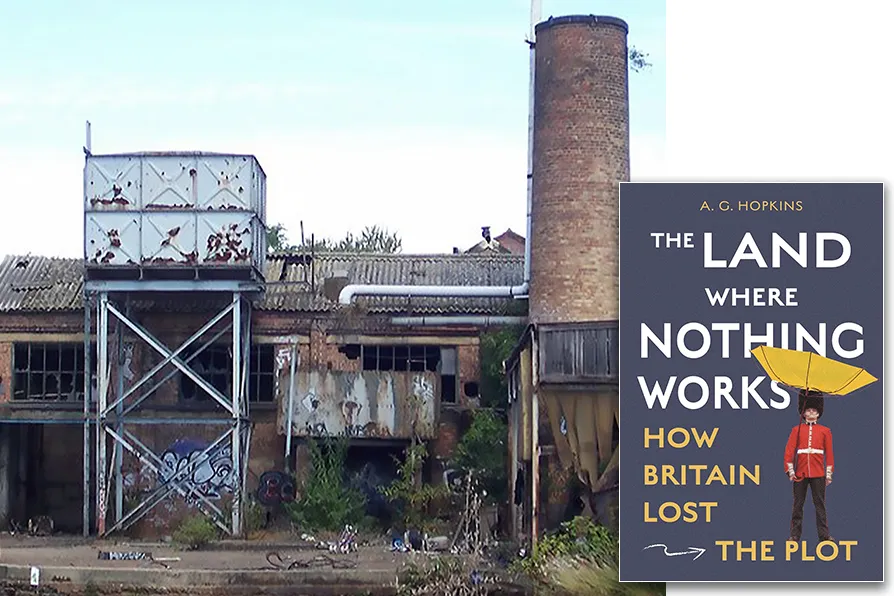 Derelict factory, Alperton, in the London Borough of Brent, 2006 [Pic: Russell Trebor]
New releases from Simone White, Brass Funkeys, and Souad Massi
SUE TURNER is compelled by a history that shows how far a country can turn in on itself to collude with abuses of power
RON JACOBS is persuaded by the parallel drawn between Charles Manson and Donald Trump
MARIA DUARTE defends a solid, late-career Spielberg conspiracy flick that calls for empathy in a hostile world


The land where nothing works: how Britain lost the plot
A G Hopkins, Princeton University Press, £25.
IN this fine book Professor Hopkins compares the post-1945 social democracy to the dire effects of Thatcherism. He shows how finance capital has become so dominant.
Between 1945 and 1973 our rate of growth was higher than earlier in the century. Unemployment and inflation were low. Real incomes rose. Between the late 1930s and 1980, asset inequality, income inequality, regional inequality and child poverty all fell. Life expectancy rose.
GDP grew by 2.7 per cent a year in the 1970s. Real household disposable incomes were 30 per cent higher in 1979 than in 1970.
Hopkins notes that one powerful incentive for the rulers to allow all this was “the need to respond to the alternative model being advertised and implemented by the Soviet Union.”
But Margaret Thatcher was brought to power in 1979 “by a counter-revolution led by those who saw an opportunity to consolidate and extend their existing privileges.”
With the 1986 Big Bang, “The city became a fully fledged, offshore tax haven run increasingly by firms whose affiliations lay outside the United Kingdom. If empire ends when the periphery takes over the centre, Big Bang was a major victory for the disparate mainland colonies that had become the mighty United States and its almighty dollar.”
Since 1986 Britain has run a current account deficit, which has been met primarily by capital inflows. This reliance on foreign, particularly US, investors compromises British sovereignty. The deficit is a result of persistent lack of investment and low productivity.
Ready access to credit using property as security became a major cause of Britain’s low rates of household and national saving. Property booms attracted savings, limiting the investment available for improving productivity and hence growth.
Between the 1990s and 2022, total fixed investment in Britain as a percentage of GDP was the lowest in the G7. Consequently, by 2023, our productivity gap with France, Germany and the US was twice its 2008 level.
Britain invested huge sums on supporting US foreign policy: £50 billion on Nato’s wars against Iraq and Afghanistan. Military spending was higher in terms of GDP than in every other developed country except the US. These costs curtailed welfare and educational investment.
Inequalities of wealth and income grew during the last quarter of the 20th century in all the developed economies, but they increased fastest in Britain because of the accelerated pace of deindustrialisation.
Recent research has shown that the richest 1 per cent held about a third of their wealth in tax havens: by 2019, this was £570 billion.
The rate of growth of GDP during the 1980s was lower than in the 1960s or the 1970s. Manufacturing continued to decline; unemployment was higher in 1990 than in 1979. The productivity gap with Britain’s main rivals in Europe widened.
After the 2008 crash, real wages did not reach 2008’s level until 2023. Between 2010 and 2019, cuts to welfare and health care reduced life expectancy by about three years.
By 2023, those on middle incomes were 20 per cent poorer than their peers in Germany and 9 per cent poorer than those in France. Our low-income households were about 27 per cent poorer than their German and French counterparts.
By 2020-21, 11.4 million people, including 3.3 million children, were in absolute low-income poverty, when housing costs were included. In 2022, 3.8 million people, including one million children, could not afford to meet basic needs and qualified as destitute.
The essence of this period of history is the decline of capitalism, as productive industrial capitalism was destroyed by the unchaining of finance capital. Hopkins logs the damaging effects of this unaccountable, unregulated finance capital.
Gordon Brown made us pay to bail out the banks, which has added to the public debt, whose interest the public pays. Now a new crisis is building, fuelled by the financial forces that Brown saved and praised as heralding a new Golden Age.
Hopkins embraces social democracy, and opposes the independence which is the necessary ground for rebuilding Britain. But the solution to our problems does not lie, as Hopkins suggests, with the social democracy of the Labour Party, wedded as it is to finance capital, and to dependence on both the US and the austerity-imposing, capitalist EU.
