JAMIE BRITTON recommends that we all buy at least two copies of a remarkable book of poems


 Latest editorial
How refusing to work will always beat capital
DAVID HARVIE recommends a selection of Harry Cleaver’s writing that documents working-class activism and offers a method, and a way of understanding and investigating the world
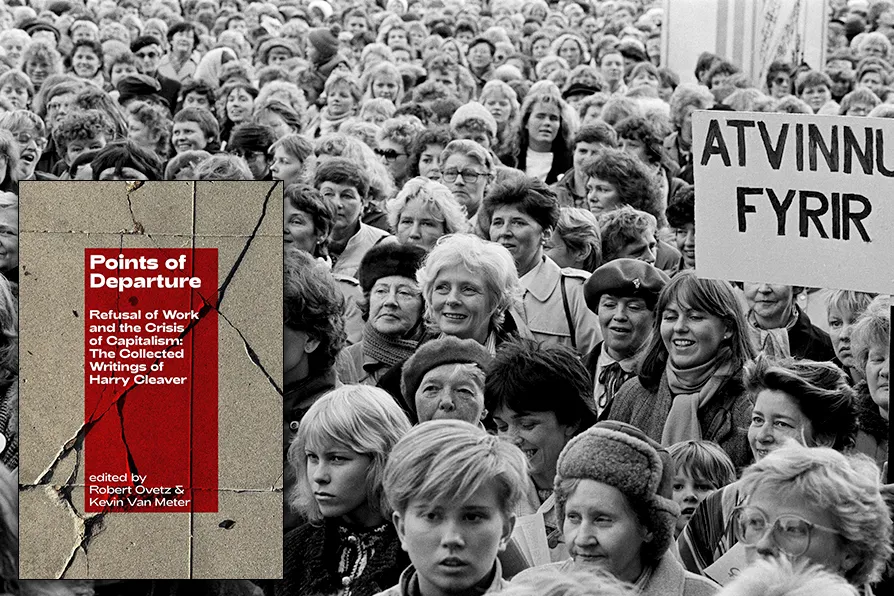 90 percent of Iceland's female population on strike, 24 October 1975, to "demonstrate the indispensable work of women for Iceland's economy and society" and to "protest wage discrepancy and unfair employment practices" [Pic: Courtesy of Krummer films]

MARIA DUARTE goes down a bilingual rabbit hole with an impressive Jodie Foster
DAVID YEARSLEY is fascinated by the account of four composers who transformed their experiences of the second world war and the Holocaust into deeply moving works of art
PETER MASON thrills to the sound of south London-born Yussef Dayes, and the galaxy of musicians drawn into his orbit
From post-human revolution in Puerto Rico to trans poetics and queer mythmaking, these three books that imagine new ways of being together


Points of Departure: Refusal of Work and the Crisis of Capitalism: The Collected Writings of Harry Cleaver
Edited by Robert Ovetz and Kevin Van Meter, Common Notions, £16.40
HARRY CLEAVER is one of a relatively small group of scholar-militants who was profoundly influenced by Italian theorist Mario Tronti’s 1966 “Copernican revolution” in Marxism. As the editors write in their Introduction to this new collection of his writings, Cleaver reveals how “capital does not act but reacts to working-class struggles against work.” Rather than seeing capitalism as “a monolith in complete control” of workers’ destinies, Cleaver instead argues that it is “perpetually in crisis as a result of workers’ refusal of work.”
As the book’s editors suggest, Cleaver’s thinking can help us to identify areas of working-class strength so that we are better positioned to “attack capital’s weakest choke points, rupture its power, and finally end capitalism before it ends us.”
Reading Cleaver in the early 1990s was a lightbulb moment for me. My comrades and I had experienced what he called “working-class self-activity” as militants in Britain’s largest-ever debtors’ movement, which abolished the poll tax and forced the resignation of the hated Margaret Thatcher, and within various other workplace and community struggles. We were able to articulate our self-activity “narratively and conceptually.” But we lacked the analytical tools to help us “determine the impact of self-activity on the capitalist imposition of work and on capitalist development itself.”
Harry Cleaver’s work helped fill the gap and it’s an absolute joy to see more of his writing back in print and accessible to new readers. As well as the editors’ informative, contextualising interview with him, this collection includes nine pieces – mostly available on-line, but otherwise only in difficult and/or expensive-to-access journals and books – organised into three sections: on the refusal of work, on the crisis of capitalism, and on Marxist theory.
Work, as Cleaver argues in the opening chapter, “is still the central issue”: it’s “still the central mechanism through which social domination is sought.” Cleaver’s is an expansive understanding of work, encompassing not only waged jobs, but also ever-expanding forms of unwaged labour – housework, schoolwork, the work of searching for the least-bad prices for electricity, gas and other essentials, the work of searching for work… And “more work [means] wider social control.”
But we, the working class, that overwhelming supermajority of humans whose lives are dominated by work, resist and refuse its waged and unwaged forms in manifold ways. “Just as we have resisted the imposition of work inside the factory or office, via slowdowns, strikes, sabotage and detournement, so too have we resisted elsewhere the reduction of lives to work… Precisely because capital seeks to intervene and shape all of life, all of life rebels, each nook and cranny of life becomes a site of insurgency against this subordination,” Cleaver insists.
Moreover, in keeping with the centrality of the principle that “workers act, capital reacts,” which Cleaver calls “the inversion of class perspective,” we must see working-class refusal of work, along with myriad struggles to create post-capitalist or communist alternatives, as coming first. What follows is capital’s response: new technology, “free” markets, development, underdevelopment, privatisation, globalisation, debt, social democracy and socialism, neoliberalism, fascism, or whatever. All are explored in Cleaver’s essays in this collection.
Most of these texts were written in the 1980s or ’90s, as interventions into the struggles of those decades and corresponding intellectual debates. But Points of Departure does more than offer a window onto that period of social change and the futures that might have been. It also offers us a method, a way of understanding and investigating the world. It shows us how we can use Marx and his categories to understand and investigate – and intervene into – the struggles of the present period.
Cleaver’s writing, then as now, can help us see that amidst the “slow violence” of climate change and the “quicker” violence of genocide, the working-class refusal of work and capital’s response to this refusal remain vital.
Co-editor Robert Ovetz will be speaking about the book and Cleaver’s ideas at MayDay Rooms, 88 Fleet St., London EC4Y 1DH, on Thursday July 16, 7–9 pm. A special pre-release publication will be available.
David Harvie is a deprofessionalised intellectual and co-author of Shaping for Mediocrity: The Cancellation of Critical Thinking at Our Universities (Zer0, 2024)
