To rescue Kahlo from the clutches of the corporate art market, we need to acknowledge the overt and covert political dimensions of the work, demands GAVIN O’TOOLE


 Latest editorial
How one profession was perverted by Nazi ideology
GORDON PARSONS regrets the price, but is dazzled by an outstandingly ambitious study of the way art restoration in particular, and culture in general was weaponised by the Nazis
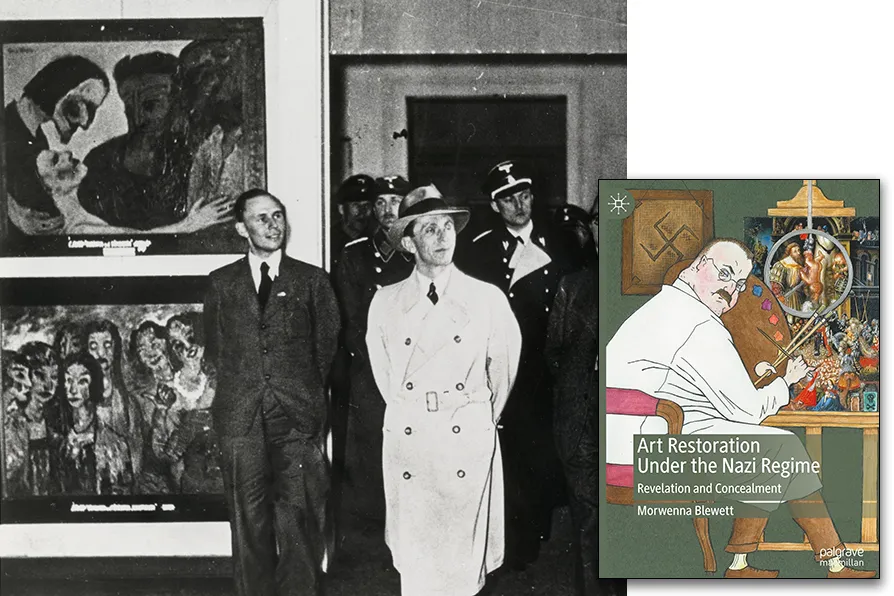 Nazi Progaganda minister Joseph Goebbels visits the Degenerate art exhibition, Munich, February 1938. On the left are two paintings by Emil Nolde, Christ and the Sinner, The Wise and the Foolish Virgins [Pic: German Federal Archive/CC]
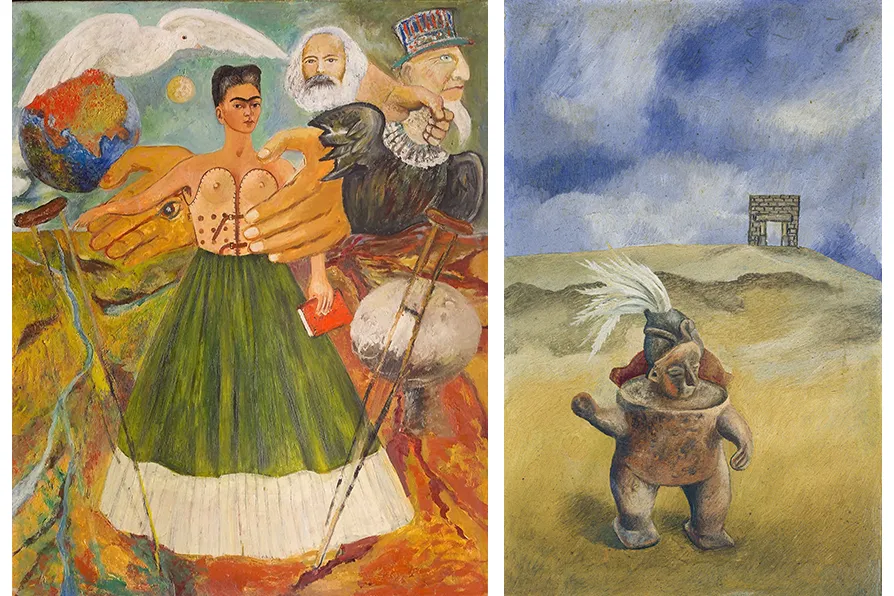
If you can see past the relentless commodification you will be rewarded by enormously powerful work, suggests JENNY MITCHELL
CHRIS SEARLE revels in the one-off collaboration between an American polymath and a British Muslim, and detects the presence of their revolutionary forebear
GORDON PARSONS revels in an ebullient production of Shakespeare’s magical comedy
BRENT CUTLER welcomes a thoughtful analysis of the Erdogan regime, viewed through the evolving history of a neighbourhood in Istanbul




Art Restoration Under the Nazi Regime: Revelation and Concealment
Morwenna Blewett, Palgrave Macmillan, £119.99
FIRST and foremost, this is an outstandingly ambitious work; work being the operative term given the scope of the technical, scientific, economic, social, political and, of course, artistic research Morwenna Blewett must have undertaken to produce this scholarly tome.
In this ground-breaking study of the role of the work of art conservationists, or restorers as she prefers to call the members of her profession, who operated within the Nazi regime, she stresses how the treatment of and response to culture within society is never neutral but always at the heart political ideology. Our own somewhat spurious culture wars reflect this in our present political arena.
The Nazis’ perfidious cultural history is, of course, well known with its notorious book burning fests and rapacious looting of European art in every country under German occupation. Blewitt’s research uncovers how all this was organised and carried out, not only by the governmental departments set up to administer state criminality but also through the ready compliance of much of the populace.
A telling aspect of the latter, revealed in detail, is the extensive work of book and document restorers who combed and, where necessary, repaired church records over past centuries to establish any trace of individuals’ Jewish heritage to further the regime’s antisemitic purges.
She notes how, like members of all professions, for example doctors, nurses and scientists, throughout the Nazi system, these art professionals were here applying their particular expertise not with any intention to preserve time-decaying artifacts but to serve Hitler’s drive to construct a “volksgemeinschaft”, a shared Germanic inclusivity of society, ruthlessly exclusive of “ethnic” outsiders and “community aliens.”
“Most restorers were autonomous decision-makers, persecutors, profiteers, and careerists, some holding prominent museum positions… Others were enthusiastic embracers of nationalistic and antisemitic ideas, knowingly aiding and abetting the systematic integration of propaganda into cultural life through their work.”
Throughout, Blewett names names, providing mini biographies of numerous art professionals who involved themselves in a system which led to the Holocaust.
She describes the way, owing to Allied ignorance or consciously turning blind eyes, that in the post-war world, a number of those “names” were able to reestablish themselves in their profession without any public recognition of their activities within the Nazi period, just as many of those who had more political hands-on roles did.
The author sets her focal study of the Nazi wheelings and dealings in the art world within a thorough context of the developing links between art and scientific technology from the 18th century onwards given the need to clean and repair damage to old masters.
“The ultimate condition of political trauma, warfare,” however, provoked a revolution within the art world when the emerging modern art movement was dismissed by the Nazis as “degenerate art.” Art became weaponised.
The general picture of the National Socialist regime is one of totalitarian control. However, while “Goebbels’ RKK [Reich Chamber of Culture] was used for the complete ideological, political, social, and economic control of German cultural life, policing creative professionals and their output, covering professions and trades as diverse as garden designers, mime artists, and postcard sellers,” under the surface there existed a chaotic world of self-interest, serving the demands of the Nazi elite and “major stakeholders.”
The book has many fascinating asides. For example, in an RKK sponsored magazine article on caring for picture frames “Zyklon B [to be eventually used in the gas chambers] is recommended to rid wood of furniture beetle but is noted as so dangerous that only specialist companies should be entrusted with its use when it comes to treating paintings.”
However, given the cover price (too expensive even for public libraries I fear) and its essentially academic form, with pages of footnotes and detailed information relevant only to fellow conservationist and art specialists, one feels sorry that a book with so much of interest for many outside that specialist world, will pass them by.
