

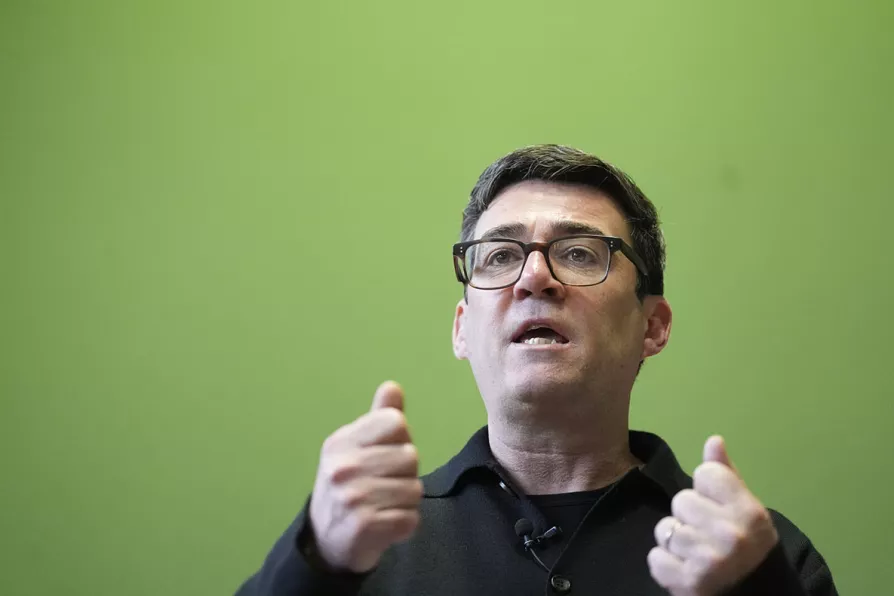
 BIG IDEAS: Andy Burnham





IN A major speech today Andy Burnham will outline his perspectives for Britain’s economic and social future — a speech to which trade unions and trade unionists need to pay careful attention. More than this, they need to respond. Because the spokespersons of the banks and big business certainly will.
The outlines are already clear. It is, first, to generalise the experience of Greater Manchester: devolving power and funding to local authorities, to decentralise, to maximise local involvement and expedite community wealth building. It is, second, to take back at least two major utilities into public ownership, energy and water, as well as strengthening public control of transport. Third, it promises a £1 billion fund to support housing development and urban infrastructure and to control rents. Finally, it promises a publicly
run care service — possibly funded by a land value tax.
These seem to be the main elements. All would help ease, if not fully address, the current crises of our urban communities.
The most immediate question is how those who administer the financial markets, maximising investor profits, will respond. The long-term question is more basic. It is how far this programme will tackle low growth, very low investment, stagnant productivity resulting from what can only be described as the piratical ownership of our economy, increasingly from overseas.
The first question highlights some of the contradictions already present in Andy Burnham’s agenda. He has committed himself to Nato targets on military expenditure – with Britain’s contribution raised again just last week. Is this compatible with the funds needed for urban and industrial regeneration?
There is also some equivocation on how far the proposed public ownership itself will be fully so and questions as to how far it would be compatible with another goal: resumed EU membership. But it is the long-term question which is the most urgent. It is the issue of who owns Britain’s productive capital and the way which the City of London acts as the midwife for the short-term speculative acquisition of what remains. One of Burnham’s advisers, former Bank of England economist, Andy Haldane, has already raised these questions and proposed taxes on funds invested overseas, tax credits for investment in Britain and measures to stop companies being “picked off by overseas raiders” — and are they enough?
But will these proposals become policy? This is why all sections of the labour movement need to engage – and, more than this, go beyond simple comment. Local communities need to be mobilised in a period where there is every danger that local government will fall under the control of those hostile to these objectives and any progressive element will come under attack from financial markets, the owners of speculative finance.
Burnham himself has described this programme as the last chance for the Labour Party. We also need to remind ourselves that the labour movement has only existed as such when it is seen to be involving people, very locally, in communities and workplaces, in campaigning for a better social system, ultimately a socialist one, but always by uniting people for specific objectives. The progressive elements in Burnham’s programme will need to be fought for in this way — at the same time as resisting the multiple cuts that are already programmed as part of Starmer’s legacy.
We must also remind ourselves of the wider picture. In 1948, after an immensely costly war but also trade union and socialist mobilisation, the share of national income going to capital was 35 per cent, much lower than it had been the 1930s. Today it is back at 45 per cent. 35 per cent today would mean another £1.4 trillion for those who work, our services and communities.
