The recent heatwaves revealed how ill-prepared Britain remains for a hotter future – and how unequal the ability to cope with it has become, write ROX MIDDLETON, LIAM SHAW and MIRIAM GAUNTLETT


 Latest editorial
Why ideas alone won’t defeat neoliberalism
The left has become too reliant on persuasion and too detached from the workplaces and communities it seeks to represent, argues NICK TROY
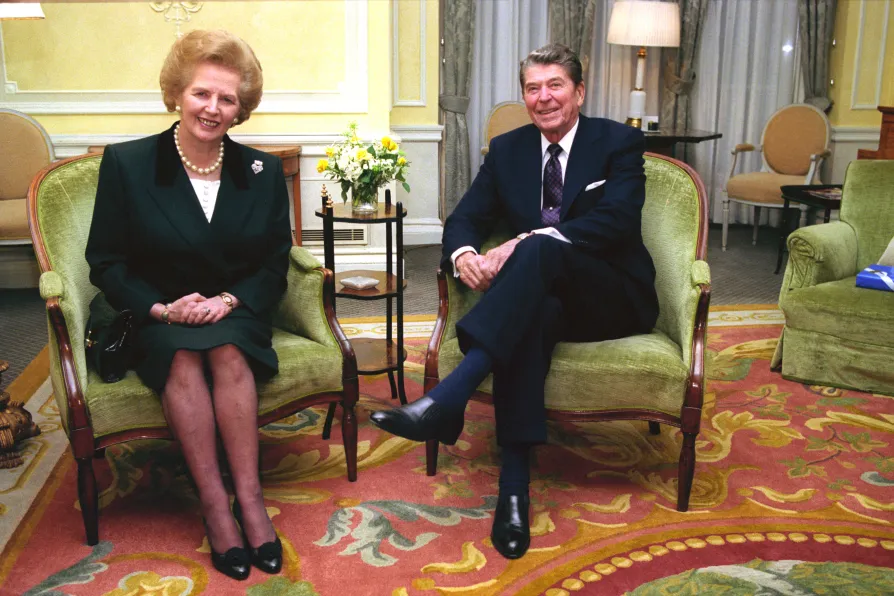 Former Prime Minister Margaret Thatcher with former US President Ronald Reagan

Extreme heat is now one of the defining public health challenges of a warming world, explains Prof IAN WILLIAMS
The US-Israeli conflict with Iran has had far-reaching consequences, including a boost to Pakistan’s regional standing, argues ROGER McKENZIE
19.01.1930-23.04.2026
Kate Clark pays tribute to Ricardo, whose life spanned the hopes of Allende’s Chile, the horrors of military dictatorship and decades of campaigning for justice in exile
Keir Starmer's early political life suggests a very different future from the one he ultimately embraced, says KEITH FLETT
After the dismissal of union representatives and years of precarious working conditions, Kimpton Clocktower workers are drawing a line, writes THOMAS BELL



MARGARET THATCHER once remarked that her greatest achievement was the advent of Tony Blair’s New Labour. She bragged that her premiership, which delivered the neoliberal model underpinning the modern Scottish and British economies, was so potent that it “forced our opponents to change their minds.”
Indeed, despite the annual commemoration of her death by many on the left, marked by stale jokes and foolish jibes, the spirit of Thatcher continues to haunt us today — namely through the dominance of finance capital, the deep penetration of US private equity into the Scottish economy, and the continued devastation of our communities through deindustrialisation and austerity. Even now an insurgent far right leads the polls, keen to advance the Thatcher project further than the Iron Lady herself managed during her tenure.
But the influence of Thatcherism was not restricted to Tony Blair and New Labour, nor was it solely a reshaping of the British political economy; Thatcher’s ideological framework has, in many respects, become the prison of the modern left.
The victory of Thatcher over the labour movement in the 1980s initiated a fundamental retreat by the trade unions and socialist movement from the communities we claim to represent. We no longer operate working men’s or social clubs, instead surrendering the social and cultural lives of our class to private interests.
Such institutions were a pillar of our legitimacy among working-class people, and played an important role in the everyday lives of their communities. These facilities served not solely as sites of political engagement, development and organisation, but as the venues for weddings, functions, and wakes. This involvement in the lives of our kind played a critical role in the strength of organisation in the British labour and socialist movement throughout the 20th century.
The cost of this withdrawal to city-centre offices and bland corporate meeting rooms is stark: trade union density, on a positive reading, is half of that of 1980. Youth membership is even worse, with only 5 per cent of young workers joining a trade union. In the hospitality sector, one of the most common questions we are asked by younger colleagues is: “what is a trade union?”
While these developments are reflective of a historic defeat, little has been done in the decades since to effectively rectify it. Instead of rebuilding that lost infrastructure, the political and industrial institutions of the left have reconfigured to operate without them, to accommodate a new reality where our primary relationship with our class is mediated through the neoliberal “marketplace of ideas” rather than the local labour club.
Instead of deriving our politics, culture, and identity from our collective role in society and the democratic organs of our class, much of our movement looks to “sell” policies, ideas and campaigns developed in half-empty meeting rooms and Zoom calls back to our class.
We have replaced leaders like Jimmy Reid and Mick McGahey — whose leadership and authority was merited by their conduct and role in industrial struggle — with self-appointed individuals who are considered the best salesmen. Such a development in itself is a muted acceptance of Thatcher’s emphasis on the primacy of the individual within society, and her scorn for the collectivist nature of our class.
The fragility of such a reliance on the individual is best exemplified by the (very) brief Your Party moment — yet another farcical chapter in the history of the new left in which interpersonal disputes and baseless factionalism torched a project once capable of engaging 800,000 prospective members.
The individual hero is for story books and misreadings of history; the greatest achievements of our class have been due to our ability to leverage our collective control over production to gain concessions from our opponents. If we are to break free from the mental prism of Thatcherism, it is imperative that we reassert that principle.
Our movement must look to utilise its huge resources to reestablish ourselves among our class socially and culturally. The impact of austerity on community space has provided us with a perfect, albeit unfortunate, opportunity to materially improve the everyday lives of our peers.
Let us focus less on changing society through the “marketplace of ideas” and provide greater emphasis through the centrality of industrial leverage: we must be aware that, without control over key sectors of the Scottish and British economies, our demands will always fall on deaf ears.
The great Red Clydesider Willie Gallacher once said that “conduct was of far greater importance than professions of faith.” For decades now, our movement has been reliant on professions of faith, on changing hearts and minds in the hope that ideas alone would be enough to confront the material might of the capitalist state. Our focus now must be on a return to conduct — in the workplace and in our communities. Re-establishing the infrastructure of our class would be a start.
Nick Troy is a member of the Unite the Union executive council and the chair of the unite Hospitality Glasgow branch and national combine.
