STEPHEN ARNELL looks at some of the notorious political corruption cases from British history


 Latest editorial
The liberal media’s great disappearing tricks
IAN SINCLAIR examines the curious memory lapses across liberal media when it comes to British government crimes
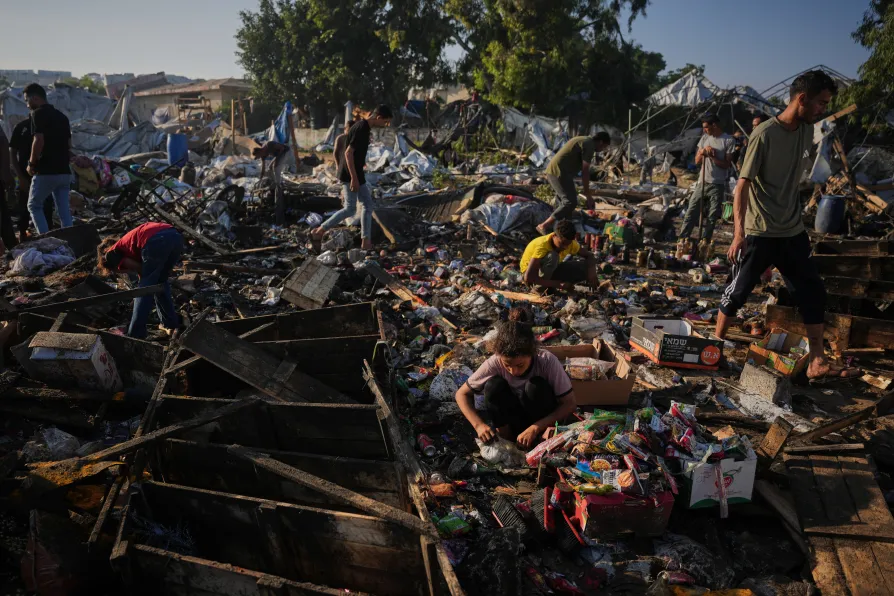 Palestinians collect food from the wreckage of their tents following an Israeli airstrike in Khan Younis, Gaza Strip, June 30, 2026
ENRIQUE SANTIAGO ROMERO says the Colombian far-right’s election victory is deeply suspect — and the United States has its fingerprints all over it
History suggests apartheid ends not through appeals to conscience alone but through sustained economic and political pressure, says HUGH LANNING
ARTHUR WEST surveys the achievements of the Scottish campaign against South African apartheid and how we can draw on them to fight a rising far right
As the US marks 250 years since the Declaration of Independence, the People’s World Editorial Collective argues that the real legacy of 1776 lies not in official celebrations but in centuries of popular struggles to make democracy a reality for all



THE liberal media puts Harry Houdini in the shade when it comes to making things disappear.
But while the magician’s famous 1918 trick making an elephant vanish was ultimately harmless entertainment, the impact of the media’s so-called journalism is extremely serious, often leading to the suppression of hugely important historical events.
First up is the coverage of Prime Minister Keir Starmer announcing his resignation.
The Guardian devoted nine pages of its June 23 edition to assessing the Labour Party leader’s record in office. In a two-page article senior Guardian columnist Jonathan Freedland argued historians will be puzzled because Starmer left office “having started no illegal wars, having triggered no grave economic crises, having been accused of no scandalous act of corruption.”
Nowhere in more than 2,000 words did Freedland think to mention Gaza, let alone the genocide in Gaza that the Labour government has been complicit in. Similarly, a 2,500-plus word overview of the prime minister’s political career on the BBC News website also failed to include the word “Gaza.”
Perhaps most shockingly, an article by the Guardian’s political correspondent Alexandra Topping looking at the successes and failures of Starmer’s premiership heralded “Success: Starmer the international statesman” without mentioning — yes, you guessed it — his role in the industrial slaughter in Gaza.
A search of British newspapers using the Nexis database by media watchdog Media Lens revealed that in the first 24 hours after Starmer resigned, there were 1,485 mentions of him. Only 30 of these made any reference to Gaza.
This isn’t a one-off. Time and again the liberal media, wittingly or unwittingly, bury inconvenient events (for the British governing elite, at least), especially when it comes to foreign policy.
For example, Topping also wrote “Trump has belittled and berated Starmer for not supporting US-Israel strikes on Iran.” This was echoed by the Guardian’s parliamentary sketch writer John Crace, who referred to Starmer’s “refusal to join the US in its war against Iran.”
Patrick Wintour, the Guardian’s diplomatic editor, went even further in April, making the astonishing claim that “Britain and Spain… have been clear opponents of the war [on Iran].”
This is simply not true for Britain. And it’s not just slightly wrong, it’s a complete inversion of reality. In the same month, in a rare moment of honesty at the Guardian, Harry Davies and Rob Evans highlighted “the vital role [RAF Fairford] has played in supporting the US’s bombing campaign” with US bombers taking off from the airbase to bomb Iran. In addition, tankers have been making “frequent flights from [RAF] Mildenhall down to the Mediterranean Sea, where they have completed aerial refuelling missions.”
Arguably the most impressive Great Disappearing Trick performed by the British media in recent times has been the expunging from history of the US-UK support for the armed rebellion during the Syrian civil war — a course of action that predictably escalated the conflict and strengthened the most violent and radical elements of the insurgency.
Liberal commentators fell over themselves to lament the supposed inaction of the West, such as the Guardian’s foreign affairs commentator Simon Tisdall claiming in 2018 that the US and Britain had been “hovering passively on the sidelines in Syria, restricting themselves to counter-terrorism operations.”
Steven Simon, senior director for the Middle East and North Africa on the US National Security Council during the Obama administration, provided much-needed reality in the same year, writing in the New York Times: “Washington did provide aid on a large scale to Syrian armed opposition” seeking to overthrow President Assad. And of course, where the US goes, Britain follows, with a 2013 New York Times report noting that British and US intelligence services were covertly working with Saudi Arabia to arm the rebels.
And while Hayat Tahrir al-Sham (HTS) and its leader Abu Mohammad al-Jolani were added to the US terrorism list in the early 2010s, in 2021 James Jeffrey, who served as Special Representative for Syria Engagement and Special Envoy to the Global Coalition to Defeat Isis during the Trump administration, described the extremist group as “an asset.” With HTS (previously the al-Nusra Front, AKA al-Qaida in Syria) in control of most of Idlib province in north-west Syria since 2017, Jeffrey noted US policy “was to leave HTS alone.”
Rarely mentioned is the crucial protection HTS received from Nato member Turkey — likely one reason its lightning November 2024 offensive quickly ousted Assad.
Speaking in Istanbul last year, then MI6 chief Sir Richard Moore referred to his Secret Intelligence Service “having forged a relationship with HTS a year or two before they toppled Bashar al-Assad.”
Lizzie Porter from the UAE newspaper The National first reported the top spook’s testimony, noting “The time frame he provided suggests it developed after the group formally severed its ties with al-Qaida, but was still banned as a terrorist organisation by the UK government for its links to the group.” Amazingly, from what I can tell the only British news outlet to report on this bombshell is the Telegraph, even though Moore’s speech is published on the British government’s website.
After Jolani, now known as Ahmed al-Sharaa, was installed as the leader of Syria, in March 2025 militias affiliated to his government carried out what Amnesty International described as “massacres” of hundreds of civilians. Just over a year later Starmer warmly welcomed Sharaa to Downing Street.
There are, of course, honourable exceptions to the tidal waves of propaganda disseminated by the British media. The Guardian commentator Owen Jones, for example, has been very critical of Labour’s record on Gaza and after the prime minister’s resignation speech wrote a takedown of Starmer for the Guardian, echoing many of the criticisms made by the Morning Star.
However, it’s noticeable Jones’s piece was online only, while Freedland’s longer article appeared in the newspaper itself, and was more prominently positioned on the Guardian website.
It’s also worth noting Jones is unable to draw attention to the elephant in the room — the role of the Guardian itself in memory-holing Starmer’s support for Israel as it carried out a genocide in Gaza.
This is because there is a rule at the Guardian that Guardian journalists shouldn’t publicly criticise other Guardian journalists. Or criticise the newspaper itself, it seems. (An aside: it’s worth noting that while the Morning Star is often dismissed as a “tankie” or “Stalinist” publication, my experience is it allows much more criticism of the newspaper itself, and writers for the paper are able to criticise each other).
Beyond these rare instances of dissent, the liberal media’s direction of travel on key foreign policies is clear — the de facto suppression of information about terrible crimes and covert actions by the British government.
“It’s helpful to think of the Guardian as the media analogue of the Labour Party,” investigative journalist Matt Kennard wrote on X earlier this year. “Same people, same politics, and same role in the British polity. They are liberal flank of the British establishment. Both institutions are set up to stop systematic change happening in this country.”
All of which means those who rely on the liberal media for their news will simply not be able to acquire an accurate understanding of how the world really works.
Handle with extreme care.
Follow Ian on X @IanJSinclair. Ian was assisted in writing this article by research previously done by the editor of Interventions Watch blog, and recommends you follow him on X @Elwinway.

Similar stories

The media present Starmer as staying out of Trump’s war — but we’re already deeply involved in a conflict that sees the US and Israel kill civilians on a huge scale, argues IAN SINCLAIR
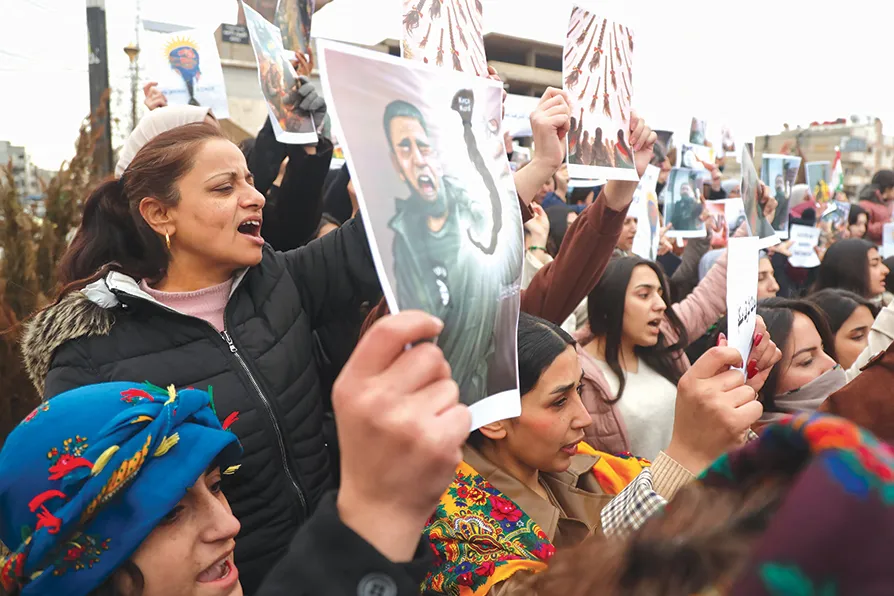
VIJAY PRASHAD details how US support for Syrian President Ahmad al-Sharaa allowed him to break the resistance of the autonomous Syrian Democratic Forces (SDF)
At the very moment Britain faces poverty, housing and climate crises requiring radical solutions, the liberal press promotes ideologically narrow books while marginalising authors who offer the most accurate understanding of change, writes IAN SINCLAIR
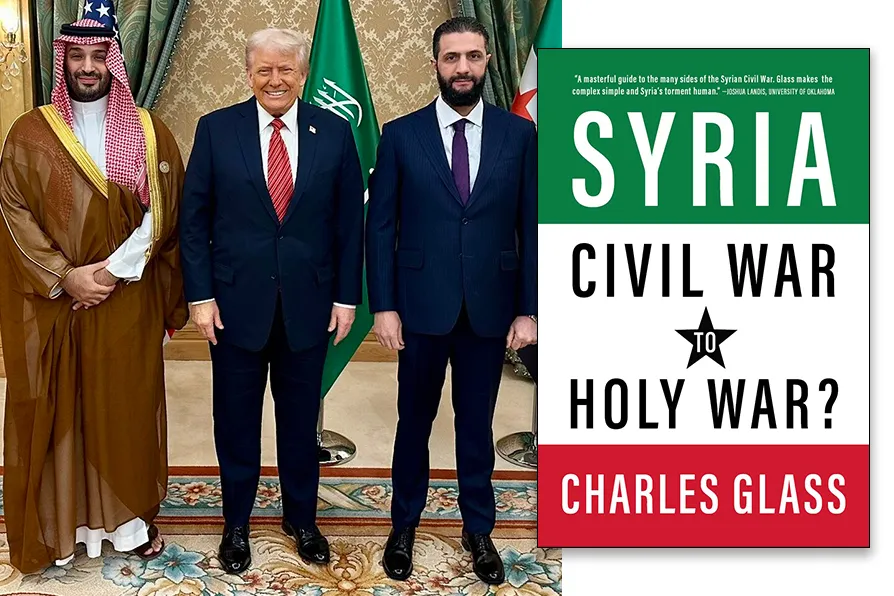
ALEX HALL follows the battered fortunes of Syria, a multi-ethnic country caught in the crossfire of competing imperialist interests