All the evidence shows voters want Labour to shift to the left — but initial signs from Andy Burnham are worrying on that front, cautions DIANE ABBOTT


 Latest editorial
‘Palestine will win!’ A word with Mustafa Barghouti
At last weekend’s International Conference Against War, LINDA PENTZ GUNTER talks to the Palestinian physician and politician about the struggles ahead to achieve a truly free Palestine
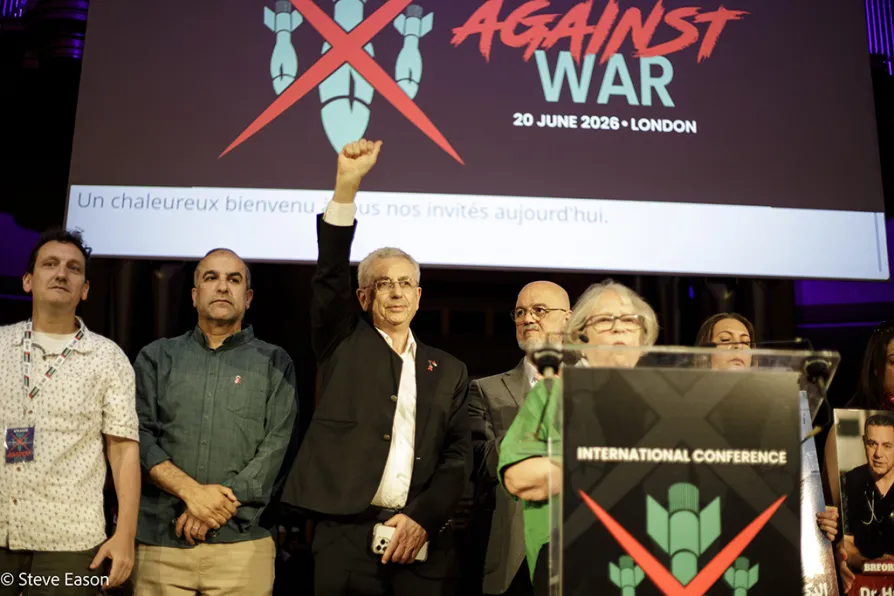 Mustafa Barghouti (fist raised) at the International Conference Against War Pic: Steve Eason
ANDY McDONALD MP says Labour must show it is capable of delivering real improvements in people’s lives — bold action is required
ANGUS REID and ANDREW JOHNSTONE report on an initiative that we must take this summer
ALLISON FEWTRELL on what Plaid Cymru's historic election victory means for the communities being failed by Wales’s housing crisis, and four things the new government can do right now
France Insoumise MP JEROME LEGAVRE speaks to Christophe Domec on building the Europe-wide peace movement that came together in the International Conference Against War last weekend




IN A COOL side room at the rear of a packed auditorium at Central Hall Westminster, Dr Mustafa Barghouti, wearing a simple white shirt, sits quietly waiting his turn to take the stage.
The occasion is the June 20 International Conference Against War, hosted and organised by the Stop The War Coalition. Barghouti is the last speaker of the session. When he eventually walks up to the dais, he is welcomed with the most prolonged standing ovation of the day.
Barghouti, a Palestinian physician and political leader from Ramallah, is the secretary-general and co-founder of the Palestinian National Initiative. To the pro-Palestine movement in Britain, he is known as the voice of morality and justice for the Palestinian people.
As we talk before his speech, Barghouti is both reflective and passionate about what needs to happen next if, as we chant so often, Palestine is truly to be free. And it is on all of us to do something about it.
“Palestine has now become the issue of the world, not the issue of Palestine,” Barghouti says. “Palestine is now the most important human and justice issue worldwide, as Nelson Mandela anticipated.”
In his December 4, 1997 speech in Pretoria, South Africa, marking the International Day of Solidarity with the Palestinian People, Mandela, then the South African president, reminded the audience that “all of us need to do more in supporting the struggle of the people of Palestine for self-determination; in supporting the quest for peace, security and friendship in this region.”
Mandela’s call to action came in the same speech as his more frequently quoted observation that “we know too well that our freedom is incomplete without the freedom of the Palestinians; without the resolution of conflicts in East Timor, the Sudan and other parts of the world.”
In that context, as Barghouti points out, even as the Gaza genocide has been eclipsed in the news by the war against Iran, “Palestine will not disappear. Because everybody knows that the real cause of all the issues here is Palestine. If there was no Palestinian problem, there would be no issue of Iran.”
Doing more, as Mandela urged now almost three decades ago, means focusing keenly on specific and pressing needs, Barghouti tells me.
“One very important issue here is to support Palestinian hostages. The whole world was talking about Israeli hostages. Now they are all home. But nobody still speaks about the more than 12,000 Palestinian hostages that are starving, subjected to terrible torture, subjected to horrible medical treatment. Many of them are suffering from scabies that is not treated, many of them are subjected to horrible conditions,” he says.
“Some of them have had their hands amputated without even anaesthesia because of the handcuffs they were put in,” he continues. “And they practice rape against people. So we want the world’s attention to what’s happening.”
Later, in his speech from the stage, Barghouti painted a picture of those Palestinian hostages “in Israeli concentration camps and prisons, subjected to being handcuffed, some of them, for more than two years — imagine, non-stop.” When infections developed in their wrists, their hands were amputated, Barghouti said, “many times even without anaesthesia.”
The other essential action, Barghouti says, is a widespread, comprehensive boycott, divestment and sanctions campaign, known as BDS.
“First of all Israel will not change from within,” Barghouti says. “Second, Israel has moved very far into the direction of fascism. Israel will not change unless the external pressure on Israel is beyond their ability to tolerate it. And that means a very powerful boycott, divestment, sanctions non-violent movement. I think the combination of our steadfastness and a strong BDS movement will change the balance of power.”
Once on stage, Barghouti made a direct appeal. “We ask you to translate your solidarity, your activism, your activities into material effect by supporting total, comprehensive boycott, divestment, sanctions against this Israeli establishment.”
And yet, Palestine remains an exception when it comes to widespread opposition and intervention by other powers, especially Israel’s longstanding allies, despite the obvious evidence of Israel’s clear aim to eliminate the Palestinian people. In Britain of course, it has become a criminal offence to support the Palestinian cause in some contexts, while other gestures of solidarity are mischaracterised as “antisemitism.”
The reason is clear, Barghouti says. “Racism. Racism against Palestinians, racism against Arabs, racism against Muslims, racism against Palestinian Christians.” And “colonial imperialist tendencies,” he adds, “protecting the interests of the imperialist powers.”
Survival will come, however, not from resilience, a word Barghouti eschews for something stronger, more proactive. “It’s more than resilience. It’s the ability to be steadfast and resist injustice,” he says, addressing the often praised characteristic of Palestinian “sumud.”
He cites an article written by his wife Rita Giacaman, an academic — Deconstructing Resilience and Reconstructing Palestinian Endurance and Resistance — published in February 2026.
“We are talking more about resisting injustice rather than adapting to injustice,” Barghouti explains. “And that’s why I call it steadfastness and resistance against all the oppression we are subjected to.
People don’t realise how difficult it is to stay in Palestine. And how difficult it is to give up so many things to remain in your country. But we’re determined to do so. Even Gazans. One hundred and fifty thousand Gazans who are stuck in Egypt are trying every day to go back.”
As a physician, Barghouti is particularly alarmed at Israel’s destruction of Gaza’s medical system.
“I just wrote an article which I hope will be published about the risk of the total collapse of the health system in Palestine,” he tells me. “They have destroyed most of our hospitals and clinics. We run a big operation in Gaza via the Palestinian Medical Relief Society. We have one hundred medical teams there dealing with almost two hundred thousand people every month.”
But these medical operations remain targets despite the illusion of a ceasefire, which Israel has now violated 3,250 times according to Barghouti.
“In Jebaliya they destroyed the clinic three times but we rehabilitated it and it’s working,” he tells me. “But we lack medications, people don’t have clean water. That’s why we have 76,000 cases of infectious hepatitis. People are suffering every day, no food, no proper water, no medications, lack of medical facilities. And they die around the clock.”
The medical crisis is not restricted to Gaza, either, he says. “They are obstructing our access into major hospitals in Jerusalem, they are obstructing movement from the West Bank to Gaza and vice versa. So they are trying to paralyse our health system. Even our mobile medical teams, which we have in the West Bank caring for the communities threatened by settlers, they are frequently attacked by settler terrorist groups.”
Those medical concerns have now landed very close to home. “My worry now is about 4,000 cases of cancer who don’t have medications, in the West Bank, not only in Gaza,” says Barghouti. “Including my wife, who I have to buy medications for which is very expensive.”
Later, on the stage, Barghouti sounds a more optimistic note. “We are the Palestinians, struggling against the growing fascism, not only in Israel but worldwide, too. Our struggle is your struggle against fascism,” he tells an audience of around 2,600 people, split between the auditorium and a second conference room.
“There was a time when it was Vietnam and the struggle of the Vietnamese people and they won. There was a time when it was the struggle of the South African heroic people against apartheid and they won. Now it is the struggle of Palestine and Palestine will win.
“They want to get us out of Palestine and we will never leave Palestine.”
Linda Pentz Gunter is a writer based in Takoma Park, Maryland, and the author of No To Nuclear. Why Nuclear Power Destroys Lives, Derails Climate Progress and Provokes War, published by Pluto Press.
