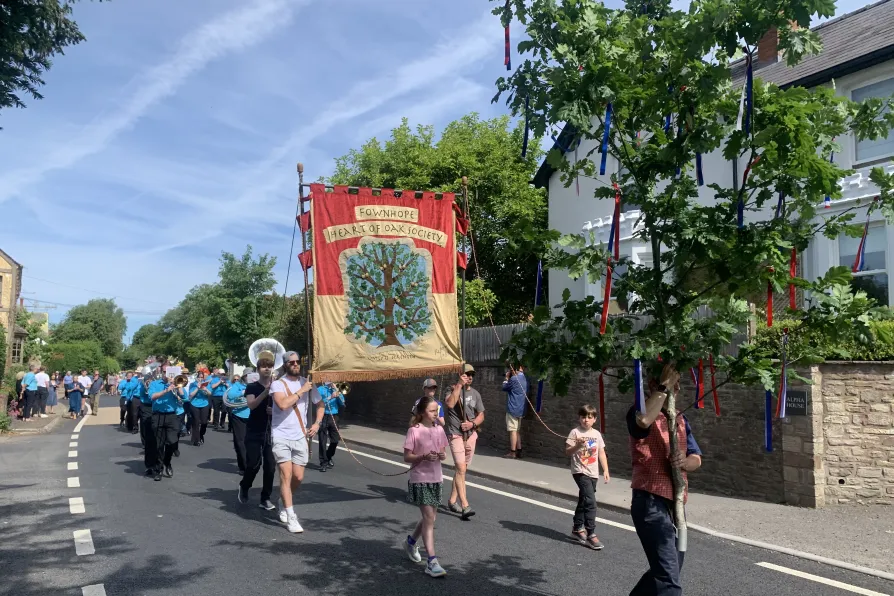
Fownhope’s Heart of Oak Society traces its roots to the age of friendly societies, when communities provided their own safety net. Its anniversary celebrations reveal a tradition still very much alive, says MARK SEDDON


 Latest editorial
The men that didn't push the button
IAN SINCLAIR explains how three courageous individuals saved humanity by refusing to follow the institutionalised aggression around them - showing the enormous impact even one person can have for peace
ANGUS REID explains the significance of Cuba’s egalitarian in letter and spirit Family Code and the pertinent lessons it holds for democracies anywhere in the world
Special report by PEOPLE’S WORLD
NICK WRIGHT considers how the isolation of Israel and a new film on the controversial Italian communist leader are creating new reference points for Italy’s left
CARLOS MARTINEZ says Cuba’s achievements in the face of a criminal blockade are startling, but the island’s future if the United States succeeds in crushing it looks bleak
AMNON BROWNFIELD STEIN reports that far-right MPs who mobbed the event organised by Hadash may have helped raise awareness of the brutality of the Israeli right




WHAT difference can one person make when it comes to influencing global politics? Very little, you might think. However, a careful reading of several crisis points in modern history throws up inspiring examples of individuals acting courageously under intense pressure to save humanity from itself.
One such person is Vasili Arkipov, a Soviet naval officer during the Cuban Missile Crisis of October 1962, whose story activist Milan Rai rivetingly tells in a 2014 article for Telesur, upon which the account that follows is based.
With the US and Soviet Union on the brink of nuclear war, on October 27, a US taskforce of surface ships and aircraft was harassing, in international waters, a Soviet submarine, B-59, on which Arkipov was second in command. In an attempt to force the submarine to the surface and drive it away from Cuba, the US ships conducted extreme sonar sound attacks on the B-59 and dropped five practice depth charges. The number is important.
A few days earlier, the US had sent a document to the Soviet forces explaining their signalling system for a ship to surface was five practice depth charges. The commanders on B-59, who were used to three warning practice depth charges as the signal to surface, never received this information.
With the submarine crew enduring temperatures of around 45ºC and dangerous levels of CO2, the captain of B-59, Valentin Grigorievitch, concluded that a war between the US and the Soviet Union had started and ordered the firing of a nuclear torpedo at the US taskforce. The firing of the “special weapon” required the consent of the captain, the political officer and the second in command, Arkipov. The political officer consented.

Similar stories

The media present Starmer as staying out of Trump’s war — but we’re already deeply involved in a conflict that sees the US and Israel kill civilians on a huge scale, argues IAN SINCLAIR
DIANE ABBOTT exposes Keir Starmer's doublespeak on Britain’s involvement in the Iran war but takes heart from the growing organisation of the opposition to it
For 80 years, survivors of the Hiroshima and Nagasaki atomic bombings have pleaded “never again,” for anyone. But are we listening, asks Linda Pentz Gunter

While Trump praises the ‘successful’ attack on Iranian nuclear sites, the question arises as to the real motives behind this escalation. MARC VANDEPITTE explores the issues