In the wake of Ann Widdecombe’s murder, JOHN GREEN wonders whether the government will really get to grips with the root cause of these attacks on our MPs


 Latest editorial
A vast US war fleet deployed in the south Caribbean — ostensibly to fight drug-trafficking but widely seen as a push for violent regime change — has sparked international condemnation and bipartisan resistance in the US itself. FRANCISCO DOMINGUEZ reports
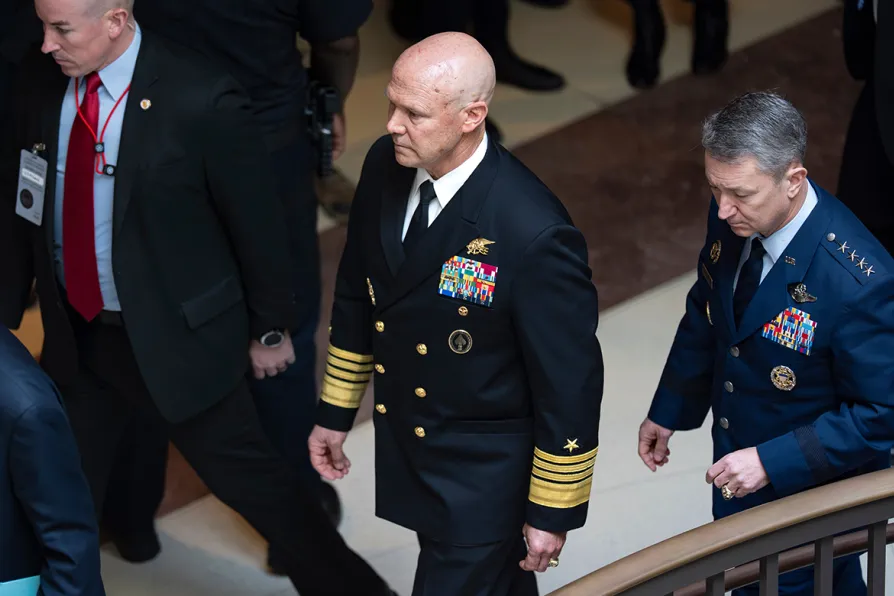 US Navy Admiral Frank ‘Mitch’ Bradley (centre) commander of the US Special Operations Command, and General Dan Caine, chairman of the Joint Chiefs of Staff (right) are escorted to a classified briefing, Dececmber 4, 2025
In the wake of Ann Widdecombe’s murder, JOHN GREEN wonders whether the government will really get to grips with the root cause of these attacks on our MPs
Despite the screeching from the right-wing media, Burnham’s speech showed that far from being stuck in the past — he’s learning from it, says Morning Star editor BEN CHACKO
Nature as well as society works dialectically, asserts the Marx Memorial Library and Workers’ School
Rising temperatures and human activity are making life far harder for these vital pollinators. ALEX DITTRICH explains
Lesbians and Gays Support the Miners co-founder MIKE JACKSON talks to Matt Kerr about the enduring power of Pride, protest and trade unionism
Behind the language of military strategy is a confrontation that risks drawing the wider Middle East into war, says STEVE BISHOP



SINCE August the US has deployed a vast war fleet in the South Caribbean Sea, claiming it is to combat drug-trafficking but really about violent “regime change” in Venezuela and aimed at taking possession of the largest oil reserves on the planet.
These threats have been dangerously ratcheted up in recent days with US President Donald Trump declaring the air space above and surrounding Venezuela “closed in its entirety” and that land strikes in Venezuela “could start very soon.”
Since early September, the US military has struck over 20 small boats, killing 83 people, actions that are tantamount to extrajudicial killings that could legally be defined as war crimes.
The Trump administration has provided no information on the people killed and has failed to provide evidence the boats were trafficking narcotics.
Both the explicit military threats of the war fleet deployment against Venezuela and the extrajudicial killings gravely violate international law, specifically Article 2 of the UN Charter. They also constitute a violation of the Organisation of American States’ charter, particularly concerning the objectives stated in Article 2 and the principles outlined in Article 3, plus many other international protocols.
There is growing unease internationally with the presidents of Colombia, Mexico and Brazil (among others) voicing strong opposition to the war fleet deployment, the killings, and the threats of illegally declaring another country’s air space closed and of an imminent military attack inside Venezuela.
UN experts Ben Saul and George Katrougalos have expressed alarm at the mounting pressure from the US on Venezuela since any “measure that seek to regulate, restrict or ‘close’ another state’s air space” blatantly violates Article 1 of the Convention on International Civil Aviation.
To them the US attacks on alleged drug-traffickers at sea — killing over 80 civilians — are grave violations of the right to life and the international law of the sea about which they said: “Those involved in ordering and carrying out these extrajudicial killings must be investigated and prosecuted for homicide.”
Opposition has also come from the UN, UN experts, the G77+China, the Community of Latin American and Caribbean States (Celac)-EU Summit, the Bolivarian Alliance for the Peoples of Our America – Peoples’ Trade Treaty (Alba-TCP) countries, parliamentarians from Latin American nations, at UN security council and the Puebla Group echoing concerns.
Pope Leo XIV, who, in a direct reference to the tension in the Caribbean, said “no-one wins with violence.”
Republican Senator Rand Paul said that US attacks on drug boats are “outrageous.”
Democrats Tim Kaine of Virginia, Chuck Schumer of New York and Adam Schiff of California and Republican Rand Paul of Kentucky said in a joint statement: “Unauthorised military action against Venezuela would be a colossal and costly mistake that needlessly risks the lives of our servicemembers.”
Senator Schiff has added that war against Venezuela has not been authorised by Congress and it is not to combat drug-trafficking but aims at violent “regime change,” adding that “Americans do not want another war.” He is seeking to pass legislation to block hostilities against Venezuela.
The chair of the US Congress intelligence committee, Republican Mike Turner of Ohio in a TV interview (December 4) said that members of Congress have made it clear that the administration has not provided sufficient information to have the support of Congress.
Additionally, lawmaker Jim McGovern (D-Massachusetts) on December 4 unveiled a Bipartisan War Powers Resolution to Block Trump War on Venezuela.
The initiative is being formally supported by Republican Thomas Massie of Kentucky and Democrat Joaquin Castro of Texas. McGovern said: “No conflict for oil, no armed intervention, no war with Venezuela.”
This is in line with US public opinion with 70 per cent of Americans oppose military action against Venezuela.
Retired four star general Barry McCaffrey said targeting the president of another nation and using the US armed forces against criminal operations — a task for law enforcement — are of dubious legality. He added that the US is trying “to get Maduro out easy or hard” and then get access to Venezuela’s oil.
Lawmakers from both the Republican and Democrat parties have expressed alarm in recent days over a Washington Post report that Secretary of Defence Pete Hegseth on September 2 ordered troops to fire for a second time on a boat to kill survivors of a first strike, who were alive and out of combat. That would constitute a war crime. The political fallout may lead to a congressional and a senatorial investigation.
The decision to deploy the US war against Venezuela was achieved by Marco Rubio claiming Venezuela is a threat to US sovereignty, labelling it a narco-state run by the non-existent Cartel de los Soles.
This is both a deceptive and an absurd pretext for war. It’s deceptive because Venezuela has virtually no role in the fentanyl trade, and Drug Enforcement Administration data suggests that only about 8 per cent of US-bound cocaine gets to the country through a “Caribbean corridor” (most of that passing through Venezuela).
The “war against drug-trafficking” fell flat on its face as highly unconvincing, when on December 2 President Trump granted a “full and complete pardon” to Honduras ex-president Juan Orlando Hernandez who was convicted by a US court to 45 years in prison for having shipped about 400 tons of cocaine into the US.
The only sensible course is, regardless of anybody’s view on the Venezuelan government, is:
Francisco Dominguez is secretary of the Venezuela Solidarity Campaign.
