MARY DAVIS says the centrality of the Jewish community and the Communist Party to anti-fascism in the 1930s is too often overlooked on the left


The M65 Corridor Zone – a chance for a new approach to union recruitment?
GEORGE WHITE explains why Unite’s Lancashire area activists committee believes co-ordinated recruitment in an area defined by particular kinds of employment and linked by a major transport artery could provide a model for organising the unorganised

 Lancashire’s county flag
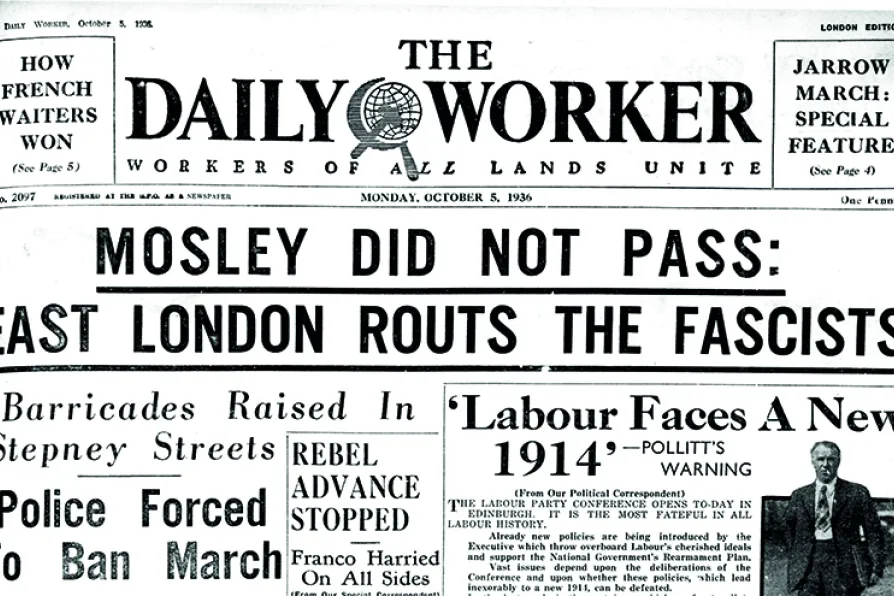
A 1936 confrontation with Mosley’s BUF became part of a wider international struggle, with local activists later joining the fight against fascism in the Spanish civil war. TONY FOX tells the story ahead of a 90th anniversary commemoration event
Voters have delivered a stay of execution for Labour and exposed limits to Reform’s advance. But will Burnham offer a political alternative rather than just a different face at the top, asks ANDREW MURRAY
Calls for a Universal Basic Income are a red herring, argues the Full Marx editorial team — socialists should fight for Universal Basic Services
SEVIM DAGDELEN warns that Germany’s military resurgence and revival of old hostilities towards Russia have dangerous implications for Europe and beyond


IN LANCASHIRE, originating from the Lancashire area activist committee of Unite, a plan is being formulated to organise workers in the geography around the M65 Motorway. “The M65 Corridor Union Zone.”
The M65 runs for 26 miles (15 junctions) from Bamber Bridge to Colne through central and east Lancashire and includes many former mill towns that experienced the post-industrial decline of Thatcher’s policies and the neoliberal economics and globalisation that accompanied them. Indeed the M65 motorway was an infrastructure project designed to stimulate jobs in the wake of that devastation from the 1970s to the 1990s.
Many of the jobs that have sprung up around the M65 have been low-pay, low-density, hire-and-fire employment. Warehousing and logistics, road transport, call centres and so on.
The area has remained prevalent amongst the boroughs and wards that are high up the table of UK deprivation and it does not require much ingenuity to conclude that the latter is the product of the former.
The area is not hostile to unions. Many people were previously members before the old industries collapsed. Those former members and their families present a fertile ground into which the campaign can be planted.
Pre-Thatcher this area was amongst the most organised with a tradition going back to the foundation of the movement and the invention of modern work in the industrial revolution.
The plan seeks to reverse this one motorway junction at a time, in an overwhelming wave of activity that intends to make union membership as ubiquitous as employment. “If you go to work, you join a union.”
It is ambitious, no doubt and will require commitment from activists across the movement, from all of the sister unions, the TUC, the trades councils, the General Federation of Trade Unions (GFTU), the Confederation of Shipbuilding and Engineering Unions (CSEU), Strikemap and any others willing to work towards the same aim.
It will require a joined up sense of union brother- and sisterhood, where each member in the union zone feels an emotional response when their sister or brother up the road comes under attack and immediately comes to their aid as though the attack had been made upon them: “Real practical and instinctive solidarity.”
It will require the buy-in of activists to convince their unions to participate, to devote resources, organisers, officers and activity for a long period of time, maybe years.
We would need to put aside internecine member poaching and foster a proper sister union mentality and develop mechanisms to amicably resolve differences around whose potential members they should be or which recognition agreements apply, before a turf war ensues. For all our mutual benefit.
There are between 500,000 and 796,000 people in the area (dependent upon which conurbations are included) with a working-age population between 417,600 and 517,400. If even a fraction of these workers can be organised it runs into the tens or hundreds of thousands.
This is why we believe that the M65 Corridor is ripe for an ambitious all-encompassing campaign.
It would be declare the area a union recognition zone and systematically target recruitment and recognition, employer by employer amongst the various demarcated workplaces, before moving on to the next part of the zone.
This should specifically not just be a paid official project, but should involve lay activists in both the planning and implementation of the M65 Corridor Union Zone.
We are not simply seeking to put on union members, but to simultaneously empower, train and equip activists with the skills needed and the responsibility for growing, maintaining and organising.
Some of the new rights afforded by the Employment Rights Act 2025 will be of use. Whilst officers and organisers should already be carrying out work to map, organise and campaign for recognition agreements, their limited numbers and their existing commitments leave only limited time to do this.
It is believed that under the new right to union access, lay members (so long as they are accredited by their union) could act in the capacity of “officials” under TULRA 1992, therefore extending both unions ability to utilise the new rights to access and our ability to push forwards recruitment and recognition campaigns.
MPs and local government, colleges, university centres, hospitals and any other anchor institutions should be lobbied and pressured to use their procurement of goods and services to promote recognition and union access.
Recognised workplaces should both be bolstered in density and bought in to the plan to push into other employers in the zone and those who supply goods and services to their employer.
An amount of class consciousness should be fostered and an idea that this is not just about terms and conditions improvements, but a whole way of seeing your place in the world and how to change it.
For any that wish to get in touch to join or support the campaign, or to encourage the buy in of your union. Please get in touch with Unite in the Northwest Region.
