MARY DAVIS says the centrality of the Jewish community and the Communist Party to anti-fascism in the 1930s is too often overlooked on the left


Keir Starmer: a political obituary
ANDREW MURRAY looks back at a damaging career marked by dishonesty, incompetence and revolting complicity in war crimes
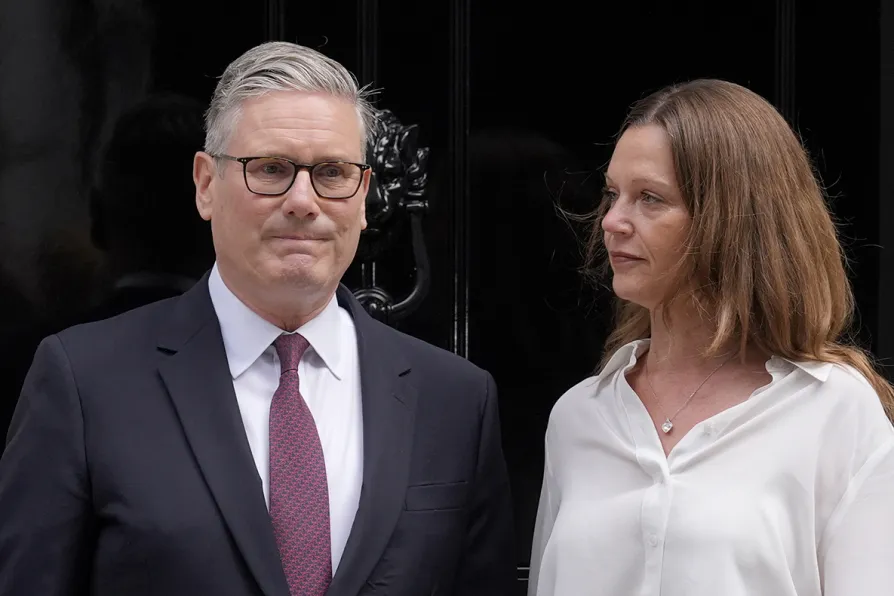
 Prime Minister Sir Keir Starmer and his wife Lady Victoria Starmer on the steps of 10 Downing Street, London, after his speech where he said he will resign as leader of the Labour Party and he has informed the King of his decision, June 22, 2026
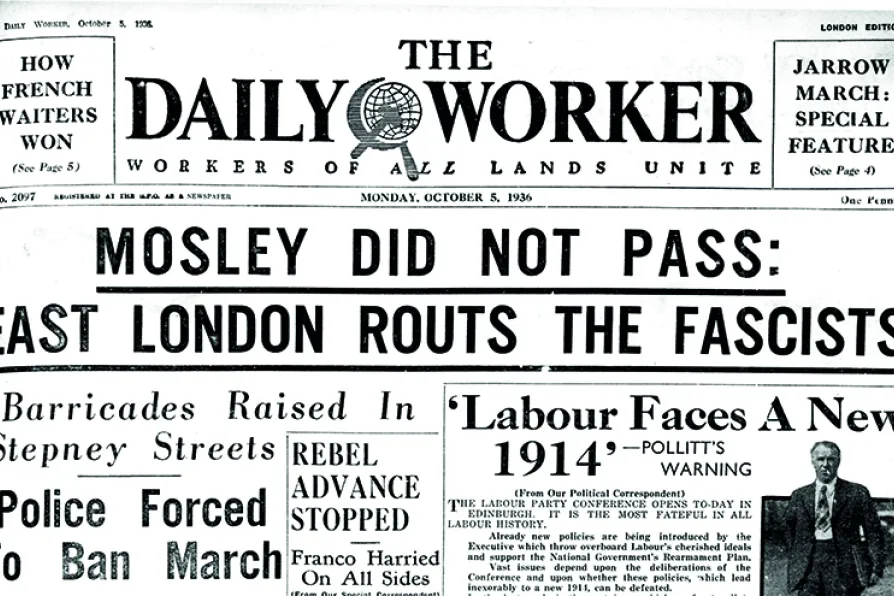
A 1936 confrontation with Mosley’s BUF became part of a wider international struggle, with local activists later joining the fight against fascism in the Spanish civil war. TONY FOX tells the story ahead of a 90th anniversary commemoration event
GEORGE WHITE explains why Unite’s Lancashire area activists committee believes co-ordinated recruitment in an area defined by particular kinds of employment and linked by a major transport artery could provide a model for organising the unorganised
Voters have delivered a stay of execution for Labour and exposed limits to Reform’s advance. But will Burnham offer a political alternative rather than just a different face at the top, asks ANDREW MURRAY
Calls for a Universal Basic Income are a red herring, argues the Full Marx editorial team — socialists should fight for Universal Basic Services
SEVIM DAGDELEN warns that Germany’s military resurgence and revival of old hostilities towards Russia have dangerous implications for Europe and beyond




KEIR STARMER’S time as Labour leader was book-ended by moments of insight.
In 2020 when he was running to succeed Jeremy Corbyn he told his team at one point “I’m not sure I’m ready for this.”
And announcing his resignation today he acknowledged that he was not the person to lead Labour into the next general election.
For the six years in between he was the most divisive Labour leader, and most incompetent Labour leader, since Ramsay MacDonald.
If he has no single episode on his record as disgraceful as Tony Blair’s promotion of the Iraq war, Starmer has an accumulation of outrages over a much shorter period in office which will leave him forever despised in the labour movement.
The former state prosecutor, who retained the state-first mentality which went with that post throughout his time at the helm of Labour, began his political ascent as a faux-Corbynite.
First elected an MP only in 2015, he quit the shadow cabinet in the aborted coup against Jeremy Corbyn the next year, but soon begged readmission.
After Labour’s great electoral advance in 2017 he worked to undermine Corbyn by exploiting the division which the leader allowed to open up between himself and his supporters over Brexit.
He posed as a champion of a second referendum and the general “Remain” campaign to thwart the outcome of the first vote, positioning himself as the champion of a generally pro-EU, if more ardently pro-Corbyn membership.
This served him well after the 2019 defeat when he claimed to offer “Corbynism with competence” to the punch-drunk Labour membership, with 10 policy pledges to back up his pretence. He thus won the backing of a section of the left, as well as state propaganda collaborator Paul Mason, a loyalist to the end.
Once elected he started shredding those commitments with indecent haste, taking Labour step-by-step back to establishment orthodoxy on economic, social and international policy.
He buttressed this with a savage attack on the left within the Labour Party, empowering the most inveterate factionalists on the party’s right-wing to purge the membership and control the selection of parliamentary candidates, all in breach of leadership election pledges of unity.
In a totemic move Starmer suspended Corbyn himself, having previously described him as “a friend,” from membership after the publication of the lamentable Equality and Human Rights Commission report into allegations of antisemitism within the party.
He then broke commitments made to then-Unite general secretary Len McCluskey to secure Corbyn’s full readmission to the party by suspending him from the whip and blocking him from standing again as a Labour candidate in the Islington constituency he had represented for more than 40 years.
Rules were then changed to ensure that no candidate from the party’s radical wing could hope to win the leadership in future — indeed under the new rules no-one would have been eligible to stand against Starmer himself had they been in place in 2020.
Backed by the secretive and law-breaking Labour Together faction, largely exposed in Paul Holden’s book The Fraud, Starmer substantially remade Labour as an Establishment party, discarding any and all commitments that might challenge the status quo or upset the markets.
He ran into a storm, however, with his full-throated backing for Israel’s genocidal assault on the Palestinians of Gaza from October 2023. Members rose in fury after he endorsed Israel’s “right” to cut off supplies of food, water and fuel to the Palestinians.
He also whipped Labour MPs to oppose proposals for a ceasefire, triggering mass resignations among Labour councillors and the rise of a movement of Gaza Independents, particularly among Muslim communities previously loyal to Labour.
This did not, however, prevent Starmer’s advance on Downing Street. The numbing incompetence of the Tory government and divisions on the right between Conservatives and the hard-right Reform ensured victory in the July 2024 election.
This was no great mandate. Starmer’s Labour won fewer votes than Corbyn had in the defeat of 2019, and three million less than in 2017. Only the split right allowed him to win back “red wall” seats lost at the preceding election, and more besides.
His premiership went off the rails almost immediately, with revelations that he and others, including Chancellor Rachel Reeves, had taken free clothing and other goodies from millionaire backer Waheed Ali, making his proclaimed “government of service” look more like a government of self-service.
When this was followed by cuts to the winter fuel benefit for pensioners it was clear that this was a government that was putting the Treasury before the people.
Relentlessly gloomy, Starmer’s incapacities as a politician came into sharp relief very speedily. Neither charismatic, nor decisive, nor a good communicator, nor strategic, he was as unsuited to the job as he once intuited he might be.
His authority collapsed by degrees. Even the parliamentary party hand-picked by his chief of staff Morgan McSweeney rebelled against more welfare cuts in 2025, forcing one of many U-turns.
Hemmed in by conservative commitments on tax, he lacked the scope to carve out a different path, improvements on workers’ and renters rights, and a slow-motion part-renationalisation of the railways aside.
On the international stage he maintained British backing for Israel while offering a masterclass in sycophancy towards Donald Trump in an ultimately futile effort to keep the belligerent president onside.
Ultimately he was most undone by his decision to appoint former New Labour top honcho Peter Mandelson as ambassador to Washington, despite more flashing red lights than bonfire night.
The gradually unfolding scandal around Mandelson’s relationship to paedophile financier Jeffrey Epstein proved uncontrollable, leading to a series of resignations from government, including McSweeney’s.
It displayed the Prime Minister’s utter faction-first moral bankruptcy. He accepted “full responsibility” for the episode, and every time he did someone else lost their job.
Far too late Starmer tried to break with McSweeney’s political strategy of appeasing Reform voters on migration and more. It availed nothing — the most loathed Prime Minister in history led Labour to historic-scale defeats in the May election for devolved and local authorities.
Emblematically, Labour lost an election in Wales for the first time in a century, polling just 11 per cent of the vote.
By then the writing was on the wall, the door, the carpet and everywhere else. Loyal cabinet members like Wes Streeting and John Healey found reasons to quit.
Starmer’s premiership dwindled to a matter of waiting for Andy, the only person with perhaps the capacity to undo the damage done.
With the victor of Makerfield on the train south, the was nothing left to do than wheel the lectern out into Downing Street once more and announce the demise of Britain’s sixth premiership in 10 years.
In a month he will be gone. But the damage Starmerism has done to the Labour Party will not easily be repaired.
Andrew Murray is Morning Star political reporter.
