Latest editorial
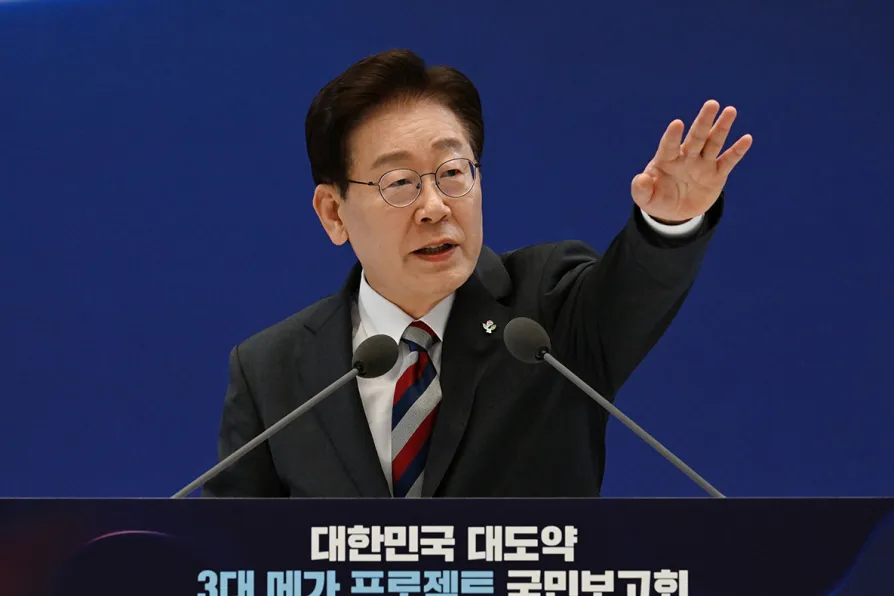 South Korean President Lee Jae Myung attends an announcement with Samsung Electronics Chairman Lee Jae-yong and SK Group Chairman Chey Tae-won at the Blue House presidential office in Seoul, South Korea, June 29, 2026


SOUTH KOREA began enforcing a law today that imposes huge fines against news outlets and social media platforms for spreading false information.
Journalists and civil liberties groups say that the vaguely worded law fails to clearly define what information it prohibits and lacks adequate safeguards for the media, warning it could potentially discourage critical reporting about government officials, politicians and large businesses.
The law allows courts to award damages of up to five times the proven losses against news organisations and large social media channels, including YouTube creators, that circulate “illegal,” false or manipulated information to cause harm or generate profit.
In addition, those who distribute information more than twice after a court has confirmed it to be false or manipulated could be fined up to 1 billion won (£493,375) by the country’s media regulator.
Social media platforms with more than a million daily users are required to take measures such as removing content or suspending user accounts when they receive reports of false or fabricated information.
The law was backed by President Lee Jae Myung’s liberal Democratic Party and passed by the National Assembly in December over a boycott by the conservative opposition.
The liberals claim the law is necessary to combat the fake news and disinformation that is fuelling division and hate speech.
The Journalists Association of Korea said that the mere prospect of news organisations repeatedly facing massive damage claims or legal disputes could have an “unavoidable chilling effect.”
“Even if a law’s objective is legitimate, it could erode the foundations of democracy if it’s enforced in a way that discourages the media and ordinary citizens from freely criticising and scrutinising those in power,” the group said in a statement.
The Seoul Foreign Correspondents’ Club also expressed concern about the potential impact on the work of the media and the free flow of information.
The push for the law came as Mr Lee expressed concern about South Korea’s online discourse and information environment after then-President Yoon Suk Yeol briefly imposed martial law in 2024.
He was later impeached and removed from office. He was convicted and sentenced to life in prison for rebellion, a ruling that he appealed in February.
Mr Yoon, who faces other criminal cases as well, has promoted unsubstantiated election fraud claims circulated on YouTube to defend his botched power grab and rally conservative supporters against the Democrats.
Critics say Mr Yoon’s campaign further polarised the country by injecting falsehoods into already bitter political disputes and making compromise increasingly difficult.
The Korea Media and Communications Commission has downplayed concerns that the law could be used as a tool for state censorship.
It would be private operators of online platforms, not the government, deciding whether reported content qualifies as false or manipulated information, and the law exempts reporting conducted in the public interest from damages claims, the commission said last week.

ANSELM ELDERGILL examines the difficulties surrounding freedom of expression