The greatest threat to democracy may no longer come from political parties but from unelected tech oligarchs like Peter Thiel and his powerful Silicon Valley network, argues JOHN GREEN


 Latest editorial
Forever wars, forever profits
Today’s interconnected conflicts are enriching the arms industry while pushing the entire world towards permanent militarisation, argues ROGER McKENZIE
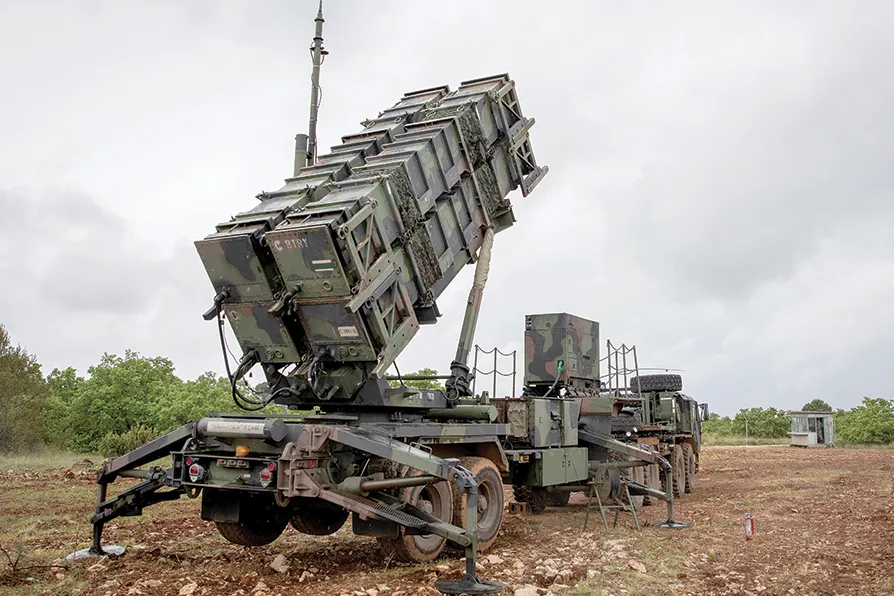 FINANCIAL BONANZA: A Nato preferred Patriot surface to air missile system, in Croatia. It has helped fill the coffers of its US manufacturers Raytheon and Lockheed Martin / Pic: Sgt Alexandra Shea/CC
by Nana Backland, Merseyside Morning Star Readers & Supporters Group
The government’s Pip review looks like a carefully managed exercise in legitimising future cuts to disability support, argues Dr DYLAN MURPHY
The Tories introduced the 50% strike ballot threshold to make industrial action harder. MATT WRACK argues that a Labour government has no justification for leaving it on the statute book


THERE are, by some estimates, around 50 ongoing wars in the world. A complete list is impossible because there is not even a universally agreed-upon definition of what a war actually is.
In fact many experts say that over 100 armed conflicts of varying sizes can be tracked across the globe.
These include the illegal and unprovoked war unleashed by the US and Israel on Iran, Russia and Ukraine, attacks by the Israelis in Gaza, the occupied West Bank and Lebanon, Pakistan and Afghanistan, clashes in Kashmir between India and Pakistan, Yemen, Sudan, the Democratic Republic of Congo, Sahel, South Sudan and Myanmar, to name but a handful.
There are many others, including armed conflicts in Haiti, Afghanistan and Mexico, as well as unprovoked attacks by the US on Venezuela and the threat of another on Cuba.
Few of these are isolated conflicts. Aside from the pernicious role of the US in either sparking or encouraging these conflicts, there is a clear interconnectedness through the major US arms companies making vast profits from the waging of war.
Given the extent of these conflicts, I can’t help thinking that we already find ourselves deep into World War III.
It doesn’t have to share all the same characteristics of the imperialist so-called Great War of 1914 to 1918 or the anti-fascist war of 1939 to 1945 not to be classed as a world conflict.
We can’t even easily put a date on when it began as we can with both those wars designated as global by the historians.
But surely, so many conflicts on so many continents and in so many countries could also be described as a world war.
To be clear, I am not wishing this to be the case but I simply wonder whether it is the case.
It also seems to be a view that is developing more legs in analyst circles.
One of former British prime minister Sir Keir Starmer’s military analysts, Fiona Hill, during the course of advising on Labour’s Strategic Defence Review, argued that World War III has already started, if only we recognised it.
War is not only a shooting match. It never has been. The tactic of siege as a weapon of war has been around for many hundreds of years.
The Cubans have been under a vicious US-led and enforced siege for more than 60 years. The US has made no real secret of the aim of literally starving and draining the lifeblood out of the Cuban revolution.
The world has stood by and watched as the Palestinians in Gaza have been deliberately starved of food aid and medical supplies by the Israelis. All sorts of excuses have been used to explain why it is impossible for Israel to “allow” more food and supplies into the enclave but the result is the same — starving Palestinians.
The war being waged against the people of Cuba as well as the Palestinians defies the wishes of most of the nations of the world but is carried out on the basis of “might is right.”
They are also carried out in defiance of international law, which has increasingly over the years come to mean whatever the US and its acolytes say it is and applied however they wish it to be.
I can see no material difference in these tactics and the siege of Stalingrad that lasted from August 1942 to February 1943 and even way back to the sieges of Jerusalem during the so-called crusades.
In simple terms it’s about starving the opposition into submission so that a political and/or military objective can be achieved.
The use of economic sanctions have the same effect.
Cuba, Iran and Venezuela, to name but three, have all been targeted for many years by this weapon of war.
European allies have made it clear that they are going full steam ahead in planning for an escalation of global conflicts.
Last May it was revealed that Britain was making plans for a “mass mobilisation” of civilians. The Ministry of (so-called) Defence said it had no plans to bring in conscription “at this time,” but said tens of thousands of civilian “volunteers” would be needed to protect the country in a war with Russia — the designated enemy.
The plan, known as Fortitude, was revealed by army chiefs in evidence to a House of Commons inquiry.
Lieutenant General Paul Griffiths of the Standing Joint Command of the British armed forces, said the government was making preparations to strengthen the protection of British military bases, energy plants and major transport hubs against attack.
Germany has been thrown into chaos over plans by the country’s right-wing government to introduce mandatory conscription into the armed forces against the bizarre imagined threat of a Russian attack.
It is not hard to see who benefits from the widening global conflicts, including increasingly frenzied talk of a Russian attack and crazy talk about hostile Chinese intentions towards the West. But it is the arms companies have never had it so good.
Revenues from sales of weapons and military services by the 100 largest global arms-producing companies reached a record £508 billion in 2024, according to data released by the Stockholm International Peace Research Institute (Sipri) late last year.
Global conflicts and ever-higher military spending, increased revenues generated by the companies from sales of military goods and services by at least 5.9 per cent compared to the year before, according to Sipri.
US companies of course led the pack with Lockheed Martin, Northrop Grumman and General Dynamics. Arms revenues of arms companies in the top 100 grew by 3.8 per cent in 2024 to reach £250bn, with a staggering 30 out of the 39 US companies in the ranking increasing their revenues.
Trillionaire Elon Musk’s SpaceX appeared in the list of top global military manufacturers for the first time, after its arms revenues more than doubled compared with 2023 to reach £1.3bn.
Excluding Russia, there were 26 arms companies in the top 100 based in Europe, and 23 of them recorded increases in revenues from sales of weapons and equipment. Their aggregate arms revenues grew by 13 per cent to £111bn.
After boosting revenues by 193 per cent to reach £2.6bn through making artillery shells for Ukraine, Czech company Czechoslovak Group recorded the sharpest percentage increase in arms revenues of any top 100 company in 2024.
Last year, weapons makers in Asia and Oceania still registered £96bn in revenues after a 1.2 per cent decline compared to 2023.
Arms revenues among the eight Chinese companies in the ranking fell by around 31 per cent, clearly reflecting that Beijing’s priorities lay beyond the military industrial complex.
Nine Middle East companies racked up a combined £23bn in revenue in 2024, showing a regional increase of 14 per cent.
Three Israeli arms companies in the ranking increased their combined arms revenues by 16 per cent to £12bn amid the genocidal war on the Palestinians in Gaza. Elbit Systems trousered £4.5bn in profits, followed by Israel Aerospace Industries with £3.7bn and Rafael Advanced Defence Systems with £3.4bn.
As well as continuing to call out the insatiable greed of the Western powers for the resources under the feet of the global majority, we must continue to call out the vast record profits being pocketed by the arms companies at the expense of the misery of billions of people.
Forever wars, whether local or global, mean forever profits for these jackals.

Similar stories
Expanding Britain’s nuclear capability increases the risk of nuclear confrontation. It does not keep us safe – it makes us a target, argues CAROL TURNER
Trump threatens war and punitive tariffs to recapture Iranian resources – just as in 1953, when the CIA overthrew Mossadegh and US corporations immediately seized 40% of the oil, says SEVIM DAGDELEN