
The campaign against the Bank of England’s ongoing theft of Venezuelan gold is gaining support across the labour movement and beyond, writes MATT WILLGRESS


A brief history of Britain’s election eccentrics
MAT COWARD introduces some of the electoral oddballs of the political fringe who remain one of the liveliest features of British democracy, despite efforts to abolish them
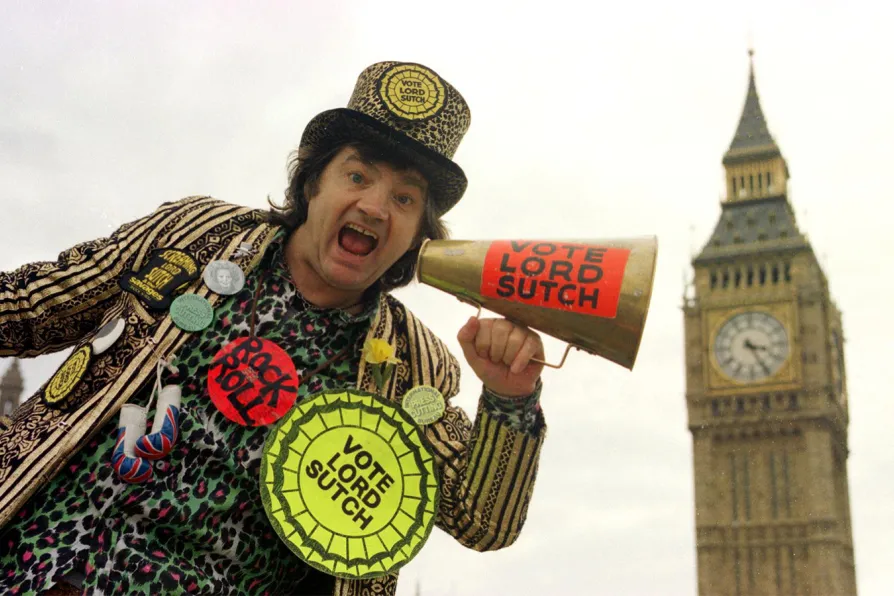
 Screaming Lord Sutch, the former rock singer who brought zany humour to British politics with his Monster Raving Loony Party

The new Prime Minister must abandon decades of automatic support for US foreign policy, which makes us all less safe, argues DIANE ABBOTT MP
Claims that Nicaragua has abolished elections followed a headline that stripped Daniel Ortega’s remarks of their historical and political context. The full speech tells a different story, says BECCA RENK FOSTER
Media Lens at 25: David Cromwell and David Edwards reflect on a quarter-century of media criticism, explaining why independent journalism is more important than ever
by Weyman Bennett and Maz’s family



BRITISH governments have been trying to get rid of fringe candidates for at least a century.
The Representation of the People Act 1918 introduced important reforms — most notably, some women got the vote for the first time — but it also included a clause which the home secretary told the house was meant to prevent “mere freak candidates.” Anyone standing for Parliament in future would have to pay a deposit, which they’d only get back if they polled at least one-eighth of the votes cast.
As recent news has reminded everyone, the scheme didn’t work. The mere freaks are still among us.
They come in several flavours. There are the idealists, the seers, the out-and-out eccentrics, and the satirical or “loony” candidates (Screaming Lord Sutch, Count Binface), jester-like characters who ridicule the process, and the pomposity of those involved in it, while at the same time producing a carnival atmosphere. Quite often, they also provide humorous or ironic critiques of the mainstream parties. I think it’s possible that this tradition began with the mock elections of the 18th and 19th centuries.
Single-issue campaigners were a big feature of by-elections in the 1980s — although in fact many of them were multi-issue campaigners who felt strongly, and almost always eccentrically, about a number of matters and tended to string them together like the sponsors’ names in a Tour de France cycling team.
Lieutenant Commander Bill Boaks, who stood in dozens of elections between 1951 and 1982, was primarily concerned with road safety. But he started out under the banner of The Association of Democratic Monarchists Representing All Women and ended up billing himself a Public Safety Democratic Monarchist White Resident. The “white resident” part caused a lot of ill-feeling, but oddly does not seem to have represented any racist or anti-immigration views.
Like a lot of the eccentric candidates, Boaks’s declared policies were a mixture of right and left — as are many people’s opinions, after all. He was in favour of equal pay for women, and at the same time concerned about communists trying to take over the country. His eventual retirement from electioneering was caused, fittingly enough, by injuries received in a road accident. It’s said that he never actually asked people to vote for him because he considered it an invasion of their privacy.
Before Bill Boaks there was Noel Pemberton-Billing, a Boer war veteran, inventor and aviator, who greatly annoyed the government by standing in numerous elections during both world wars, mainly to promote the importance of air power in modern conflict and to urge the bombing of Germany.
Unusually, he was actually elected to Parliament as an independent (in 1916 and ’18), before becoming a bona fide fringe candidate in four WWII by-elections all of which took place in 1941. In between he had been involved in a sensational libel trial, after publishing an article entitled The Cult of the Clitoris in which it was alleged that the Germans had a list of “47,000 highly-placed British perverts” of both sexes who were being blackmailed into sabotaging the war effort.
The World Government and Old Age Pensioners’ Party, founded and led by a former Liberal parliamentary candidate and Conservative Central Office staffer, contested the Bath seat several times between 1964 and 1983. It advocated a single worldwide parliament, the abolition of all nations, scrapping nuclear weapons, and turning Buckingham Palace into an old folks’ home.
The Elvis Presley Party contested the 1984 Chesterfield by-election, proposing to replace local rates with a tax on Cliff Richard records.
The following year found Captain Rainbow’s Universal Party describing its own launch event as “an unmitigated disaster.” George Weiss, a well-known character in Hampstead, had booked a steel band and an open-top bus and bought 1,000 balloons for the occasion, and invited the world’s press to meet him at the top of Parliament Hill. Nobody turned up. Except George.
He too wanted to abolish borders, as well as money and Parliament. His ultimate aim was a world governed by a god-like artificial intelligence which would administer a universal income named The Wonder. No-one would have to work and no-one would suffer want.
“Rainbow George,” as he was known around the village, came into a lot of money after “acquiring title by adverse possession” of a house in a fashionable road. But he must have spent most of it over his many years of lavish electioneering and on sundry other campaigns, such as promoting a referendum on renaming Belfast as Best City (after the footballer). On one occasion he hired Camden Palace for a concert which cost a penny to get in and a pound to leave. Rainbow George was still running for Parliament in his mid-seventies.
Public and press events which fail to attract a single member of the public or press are not unusual in this field. But the start of Walter Normanton Reed’s campaign for the Bristol Central seat in 1943 was still quite special: the self-declared president of the Society of Angelic Revelations booked a room at the Royal Hotel for a meeting at which he would formally announce his candidature. Predictably, no citizens turned up. Unsurprisingly, only one local journalist turned up. Rather more disappointingly, the candidate himself did not turn up.
Reed, aged 83, admitted that he was the only member of the Society of Angelic Revelations, “Thus the presidency falls on me.” His main strategy in the by-election was to ask the Conservative candidate, favourite to win the seat, if she would stand aside in his favour. (She wouldn’t.)
The Warrington by-election on July 16 1981 was seen at the time (wrongly, it transpired) as a turning point in British political history, when the newly formed Social Democratic Party ran Labour a close second. There were actually three Labour candidates on that ballot paper, along with two SDPs: apart from the “real” ones, voters could pick United Democratic Labour Party (149 votes), Independent Labour (53), or Social Democratic (38).
Bill Boaks was there, of course, (14 votes) way behind the Citizen’s Band Radio Party (111), but ahead of the English Democratic Party (11) and More Prosperous Britain (10). Just for context: the winner received 14,280 votes.
Further efforts were made in the 1980s, and in the 1990s, to curtail the “mere freaks,” and again they failed. It is quite likely that current events will prompt another attempt, but if so that will surely fail too. And thank heavens for it. The fringe candidate is not only part of our cultural heritage — generally harmless and occasionally beneficial to democracy. It is not only a flash of fun in drab times. It is not only a platform for rebels of every type. It is also, in a political system which does not offer the option of voting “None Of The Above,” a crucially important means by which voters can register a protest against the state of politics as a whole.
(And needless to say, at least two people have, in fact, stood as the None Of The Above candidate in British elections.)
You can sign up for Mat Coward’s Rebel Britannia Substack at www.rebelbrit.substack.com for more strange strikes, peculiar protests, bizarre boycotts, unusual uprisings and different demos.

Similar stories
MAT COWARD writes on Ghost Runner John Tarrant
MAT COWARD tells the story of the eccentric founder of a short-lived but striking experiment in ‘vital democracy,’ who became best known for giving away his estate to the nation
‘Honest’ Tom Wharton’s 1682 drunken rampage through St Mary’s church haunted his political career, but his satirical song Lillibullero helped topple Catholic James II during the Glorious Revolution, writes MAT COWARD
While an as-yet-unnamed new left party struggles to be born, MAT COWARD looks at some of the wild and wonderful names of workers’ organisations past that have been lost to time